Showing posts with label FERNS. Show all posts

Friday, 26 June 2020

30 DAYS WILD : 26 - DRAWING TO A CLOSE

Hart's tongue fern in wall. June 16th 2020
Seeing this Hart's tongue fern in someone else's wall (June 16th 2020)
inspired me to find out more about how to look after them.
I've cleared away some clutter from in front of those
in my own wall and have been drip-feeding them plant food.
After today, there will be four days of '30 Days Wild' left - a challenge set by the Wildlife Trusts to do some random act of wildness every day in June. The 'wild' ideas they suggest have not been very 'wild', not in the way of the street parties which have been breaking out around the country as lockdowns are lifted . . . they have been things like going for walks, for picnics, for listening to the birds, watching out for butterflies.

It has coincided with other challenges in all our lives. For my part, in the early days of the month I could not go out at all because I was 'shielded'. More recently, we 'shielded' people have been encouraged to go for walks as long as we keep away from others so I have swung from being totally at home and pretty inert to walking in remote places and scurrying along for the sake of exploration and to re-animate my body before it gets too sluggish and slow.

I've managed quite a few of the 'challenges'. I planted some corncockle flowers for the sake of pollinators. (They didn't come up.) I checked there is water both for the frog at my allotment and for the birds but as I'm allotmenteering by delegation instead of in person I haven't the photos to show you. But it's there.

Wildlife Yoga poster
The Wildlife Trusts sent an email poster with 'Wildlife Yoga' positions. My next door neighbour, with whom I now share a long-distance cup of tea every morning, suggested we should add outside yoga into our routine. 'What, in front of all the people passing?' No! And I haven't taken up the suggestion that I should make a mandala out of leaves and things either. (A sort of circular pattern which I think is supposed to be meditative but . . . )

Sycamore seeds. 13th June 2020
I suppose these sycamore seeds (13th June 2020} could have
been turned into an artistic arrangement but I got carried
away by looking at the inevitable aphid . . . and wondering
whether the two sizes and shapes of seeds came from different trees outside my house.
Then I realised - that despite there having been plenty of blossom
on both, one has masses of these winged 'helicopters'
or 'keys'but the other has none.
Can you spot the aphid? (Clicking the picture will enlarge it.)
So it's been a bit of a mixture. Some things I've done. Some things not. I think perhaps I've been a bit lacking on the artistic front. I included a poem but I've not drawn any drawings. My photos are my 'art' so maybe it's a good moment to introduce you to 'Message in a Milk Bottle'. Until I got leukaemia I used to post a picture there every day. And I have, from time to time, on and off, since. But mostly, recently, Message in a Milk Bottle has been neglected. Unlike on Loose and Leafy there are no words - just the photos. The discipline of (almost) daily posts on Loose and Leafy for June has been gearing me up for going back to posting on Message in a Milk Bottle. Loose and Leafy will gradually drift back now to a post roughly once a week but if you like my work you might enjoy Message in a Milk Bottle on the days in between. I'll aim to start again at the beginning of July. In the meantime you might like to browse what's already there.

It isn't all nature - perhaps about two thirds. It depends what I'm doing and what's around. I like shapes and colours and walls and things dropped on pavements and bits of plastic caught in barbed wire too.

Digger on a Hill. West Yorkshire
Has doing the Wildlife Trusts' Challenge changed me in any way? I think perhaps it has made me more self-aware of what I am looking at. After all, a post a day calls for rather a lot of concentration. And I've become more aware of my place in the landscape. The photo of the digger on the hill is the kind of picture I would usually post on Message in a Milk Bottle but this digger is so prominent it has become a sort of Pole Star on some of my walks.

Cherries fallen from a tree (ornamental?) onto the tarmac pavement. 21st June 2020
21st June 2020
And I've become more aware of some of you. Some who have been reading and commenting on these posts are old internet friends. Some have newly arrived. As I potter around the house, noticing the presence of woodlice in the cellar and the strange absence of spiders, as I've left my vase of flowers to decay on the windowsill so I can watch the petals fall, as I've counted the sycamore seedlings I've pulled out of the pots in front of my house . . . I've been chatting with you in my head. Some of these conversations have turned into posts. Others, you may never know about. For both, thank you. Thank you for accompanying me - in my head as well as on our screens.

Links:

Friday, 19 June 2020

30 DAYS WILD : 19 - MAKING CHOICES

Ragwort by downpipe
Every so often, the Wildlife Trusts sends emails to those registered for 30 Days Wild with suggestions of what they might be doing for their 'random acts of wildness'. One of them recently is to go litter picking. Gathering litter is a bit of a challenge. Not only am I currently extra-wary of germs there's always the problem of what to do with the product of one's 'gatherings'. Most weeks the council collects things to be re-cycled (paper, plastic bottles, cans) and food-waste; but 'residual waste' (i.e. more or less everything else) is taken once a fortnight - and sometimes there's a delay with that. Even a short excursion to pick up crisp packets, stray plastic bags and fish and chip cartons can land one with more 'stuff' than will fit even in a big black wheelie bin when combined with one's own accumulated bits and bobs of packaging etc.. And if it doesn't fit in the wheelie bin, it won't be taken away.

Plants growing through tarmac tend to damage it.
I do put things in my bin if they land up outside my house, whether they have been dropped there by passers by or blown there from further along the terrace. But street responsibilities don't stop there. What about the plants which grow in the gutter or up through the pavement? For all that I enthuse about wild plants in the street, I remove these too. Plastic bottles and cans come bobbing along when it rains, form log-jams against any plants they come across and water pools across the road. It gets in the way. If there were any traffic, pedestrians would get splashed. I've been splashed. I didn't like it. Plants which come up through the pavement tip the slabs into an angle and people trip. Plants which push their way through tarmac cause cracks and the pathway disintegrates. So I pull them up too. When I'm doing this 'street tidying' I don't feel in the least bit 'wild', I feel fuddy-duddy and mean. I can even sense some of you looking over my shoulder, being critical, saying 'I thought your blog celebrates street plants?'. Well it does. But even they have to be in the 'right' place. 'Nature' is pretty strong. We humans can be overwhelmed. We aren't always as indomitable as we think. Let buddleia take root in the tiles of our roofs and our houses will fall down.

Quite a lot of us have become interested in the way the coronavirus pandemic has led to an increase in plant-life. Verges have been left un-mown. More plants than usual have been left unmolested in urban settings. Which means ordinary citizens are having to decide 'what is to be done'; what is to be removed and what should stay. It's not just me.

Maidenhair spleenwort (I think) in wall and yellow poppies at its foot.
And so it was, that when I was photographing a wall full of ferns (Maidenhair spleenwort do you think?) with flowering yellow poppies at its feet, a voice came shouting across the road,

"THEY ARE POPPIES'. 

I knew. I turned to see who was telling me. A woman who lives in that street explained from a healthy 'social distance' that she had pulled out other plants along the foot of the wall but had left the poppies on purpose. I really like this. It mean these poppies are not here by chance but by choice. Someone had chosen to leave them - and that is as much a choice as it would have been to have put them there in the first place.

Ragwort and dandelion against wall.


I have a neighbour who lets ragwort grow in a pot outside her front door each year. I do love this neighbourhood! And ragwort is currently almost everywhere. Dandelions have stopped flowering but we still have lots of yellow flowers. A spontaneous 'Britain in Bloom'.

Teasel growing against a wall.


I've even come across a teasel. This is my biggest surprise. Not only has it been allowed to grow taller than me, it seems to be the only one. How did it get to be there? It has three seed heads. Maybe there will be more teasels next year. 

Badge and Link to 30 Days Wild 2020
Today's Random Act of
Wildness is to
pick up litter and
choose which flowers
can stay in the street.

Tuesday, 2 June 2020

30 DAYS WILD : DAY TWO - HARTS TONGUE FERN IN WALL

Harts Tongue Fern (Asplenium scolopendrium) in wall.
Harts Tongue Fern (Asplenium scolopendrium). June 1st 2020
Yesterday morning I sat in the sun with my neighbour. Long distance sitting. I brought out a chair and a cup of tea and sat in front of my front door - the first time I've done this since Lockdown. She sat on the wall outside her house, also with a cup of tea, and we bellowed at each other. Our doors are much farther apart than two metres but despite that it was very companionable.

And while I was sitting there . . .
no
pause
. . . simply sitting there in the sunshine with the trees above us and my trays of brussels sprouts and rudbeckia between us . . . that can count as one of the 'wild' things I did yesterday. Nothing more 'wild' and less tamed than fresh air and sunshine!

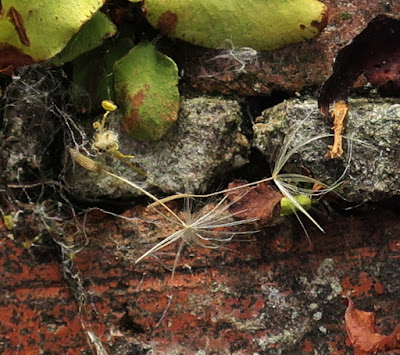
Anyway . . . while we were sitting there, I noticed these scruffy ferns in the wall. I guess they are Harts Tongue ferns (Asplenium scolopendrium) but they are very small and very sad. I'm used to Harts Tongues being a foot tall and a deep green and growing directly out of the ground in the Dorset woodland. However, the remarkable thing about these is not really that they are so dilapidated but that they are there at all. No water. No earth. What nutrition?

Close up showing dandelion seeds.
Dandelion seeds?
Also to be noted are the added 'extras' that only really get noticed later. I could already see the plants were sort of dusty as well as pale. Indeed, I had briefly wondered if I should tidy them up a bit before photographing them - a gentle sprucing with a handbrush or something. But that way you miss things. As well as the inevitable threads (what are these threads that are in all the pictures?) and bits of  spiders webs, there are seeds. Looks as if they are from dandelions. Ah . . . dandelions!

30 DAYS WILD
Today's act of
random wildness is to
sit in the sun and
look around.

Monday, 29 July 2019

TREES IN A TREE

Fern growing in a tree. Halifax, West Yorkshire.
Hello. This is an 'I'm still here, really!' sort of post. I have had the bone marrow stem cell transplant and am waiting to see if it's 'worked'. So far, so good - but nothing is definite yet. What a lot of anxious waiting!

But I'll put some pictures here of one of my favourite local trees. Not only is it huge and rugged but it supports an extra burden of plants and even trees growing along one of its lower branches.

There's a magnificent fern.

Dandelion on a branch of a tree.


And a dandelion.


Sycamore growing on another tree.


A sycamore.

(Which is not as sickly as it looks. I adjusted the image to make it easier to see against a background of other leaves and managed to sap it of all its nutrients in the process.)

Tree (beech or alder?) growing on branch of older tree.


And a . . . beech? alder? Anyone?

I think the host tree is a lime . . . . but I'll be in hospital for several more weeks so we'll need to leave that hanging.

Hope you are all well.

Sunday, 27 May 2018

AN OUTDATED STREET PLANT POST (Should have been posted at the end of April.)


I'm horribly disorganised. When I first wrote this post at the end of April, we were well launched into the first dandelion season of the year. It was freezing cold but there were dandelions everywhere. I need not have worried that I'd miss them when I left Dorset. Not only were they unmissable but in some places nature had arranged them so beautifully it was as if they had been flower-arranged.


There's a surprising amount of countryside in this very built-up Halifax. Even outside the wooded ravines which cut into the town there are reminders of what happens when a tree falls. This fungus is growing on a the remains of a lopped trunk in a car park.


And earlier in the day I'd came across violets on a small patch of earth outside an abandoned house.

Then there are walls. Non-stop walls. Dry stone walls around almost everything: gardens, fields, industrial premises. These are wonderful places for plants to dig their roots into - and I've been surprised how little the walls seem to crumble under such invasion. Of course, I should have put a photographic illustration of this here but I didn't. All a bit of a rush! And since then I've been busy doing the usual excuse type things like digging acres of mare's tail out of my allotment. But the point I was heading to at the time was that not even the flat fronts of buildings can deter a determined fern.


And drains. In Dorset I grew a habit of looking down drains to see what's growing there. Drains rarely disappoint. They are a bit like the shells hermit crabs grab. They look pretty similar on the outside but you never know who or what's lurking inside till you look.


And trees. No urban garden would be complete without trees. I think this is the most spectacular I've come across. Can it be a silver birch?


Sorry for the delay. Someone found my glasses for me. They are gold rimmed which makes them extra difficult to find unless I am already wearing them. But anyone else can lift them up and say 'These?' But other things have been getting between me and Loose and Leafy posts too. Like a plasterer putting up an acoustic wall, local elections in Halifax and civil unrest in Armenia.

We all have backstories!

P.S. I really do recommend that you read about Hermit Crabs.

Saturday, 31 March 2018

STREET PLANTS AT THE END OF MARCH FOR THE BEGINNING OF APRIL

Stong groundsel plant beside a stone wall.
This is a picture post. There's not much to read. If I had lots to say, I'd say it. But today, I don't. I'll let the plants speak for themselves. Or, rather, not speak for themselves for they are pretty quiet at present; battered by frost and snow, constantly being deceived into thinking it's spring when it isn't.

The exception is this groundsel which seems pretty chipper. I've never described anything as 'chipper' before but the word seems to fit. The angle shields it both from north and east winds and for the moment it's not garlanded with litter.

Ferns in a stone wall.
For the most part though, I look higher up walls to find plants. I've never lived anywhere with so many stone walls before. All seem to be built in the same way; two walls built parallel to each other and the gap between them filled with smaller stones. On top of these is a layer of long stones laid horizontally, with a row of quite hefty, sideways stones on top. The work which must have gone into these walls must have been phenomenal. The tonnage, mind boggling. And because of the topography here, some are waist or shoulder high on one side but way, way higher on the other.

Dandelion growing in the gap between stones on a stone wall.


Here are dandelion seedlings beginning to look out newly on the world.

Foxglove in the gaps between stones on a stone wall.


And foxgloves which have overwintered are beginning to green.


This is common but I can't name it.


A dilapidated ivy leaved toadflax would you say?


And the always-interesting shape of an unfurled willow-herb seed pod.

All these plants were photographed on 30th March, ready for the first of the month posting. Daft. So I'm moving the street plant posts to 20th of each month. I'll put a link box then too - and afterwards always on the 20th.

In the meantime, if you have a street plant post that you'd like us to know about, do put its URL in the box below.

(The site which provides the link box seems to have gone down . . . and the link box has vanished along with it. By the time I next look, hopefully it will have reappeared. In the meantime . . . . if you have a Street Plant Post to share - leave its URL in with the comments.)


Thursday, 1 March 2018

STREET PLANTS IN MARCH

Blades of grass and a grass flower peeping above snow on a street corner.
With as much snow being blown up into the air as there is snow falling, it's not a good time for a street plant post. Last month, the snow had turned to ice so the ground was dangerously slippy. This time it's soft and fluffy; so while the grip under-foot is better, the wind is able to gather it up and blast it sideways across the road. When I lived on the south coast I wished I had an underwater camera. Now I wish for one which wouldn't mind snow; though there are moments when it would be pointless to take pictures anyway for one can see nothing but white.

I noticed this little grass flower (above) on a corner yesterday. If I were to go back now, it would be buried.

Fern growing on a terrace chimney.

Between posts, we've had some non-snowy weather. On one of these days I saw a fern growing on a chimney (24th February); a change from the ubiquitous, wall-destroying buddleia.

(You might need to enlarge the picture to see it. It's growing between the bricks and concrete on the middle chimney.)

Little grass plant next to a stone wall.


Also on 24th February: this other little grass plant.

None of this is superbly exciting but it is reassuring  Nature chugs on. We know it. But we like to see it too. 

Meanwhile, the National Grid has announced it may have run out of gas by the end of today which means some of those who are losing a day's wages because they have not been able to go to work because of the snow may also go cold this evening. The National Grid is trying to persuade industry to go easy on gas - even to the extent of being prepared to buy it back or something. I looked at their site and they seem to be open to offers. (I think.)

P.S. Nothing to do with street plants: I've taken over another part-allotment with a small greenhouse and a larger one which doubles as a potting shed big enough to have a table and chairs in. How's that for good fortune?

If you have a post about the plants growing wild in the streets near you, do add your post URL to the box below.

(P.P.S. The Mister Linky gadget asks you to comment after posting a URL. You don't need to post a URL to comment, nor do you have to comment - though please do because I'm always delighted to read what you say!)

Saturday, 20 January 2018

WALL - A STREET PLANT POST

Selection of plants growing on a wall in Halifax, West Yorkshire.
I've decided, for the moment, to keep comparing. Contrasts are interesting. They matter.

The dark walls of Halifax and the surrounding fields bothered me when we arrived. Gloomy. I wasn't sure whether this blackness is intrinsic to the stones the walls are made from or whether it's soot. London used to be black. Westminster Abbey used to be black. Look at it now!

And I can't answer this yet. (Don't worry. I'll find out. Plenty of time.)

I'm getting used to them. What's more, they are a good place to find street plants. So it's another new experience - to look sideways and up, not just down by my feet.

The picture above . . . I think I'll have come back to this exact spot when I do my next 'stuck foot' post. I'll take photographs just of the plants in this immediate scene. So many crammed in together.

Groundsel in front of a wall. West Yorkshire.

Here's a confluence of themes. I'm getting used to a green instead of white light when it rains and finding it's interesting to notice familiar plants in a new context. Groundsel; but camouflaged. The plant and the green on the wall in the rainy late-afternoon light of a January day are in harmony. A unity. An invisibility. It's a surprise. A new experience. When it rains, black walls turn green!

Delicate plant with dark green leaves growing in cracks between stones in a wall in West Yorkshire.


I don't know what this plant is. Can you tell me?

Plant growing in shelter of stones of a wall in West Yorkshire.


What about this one?

This fern below?

Fern growing between stones in a wall. West Yorkshire.

Does it strike you that the stones look like petrified wood?

Why is this ivy red? Can anyone explain?

Red leaved ivy growing creeping to the top of a wall in West Yorkshire.

And below - a foxglove!
Until I came here, I'd not thought of foxgloves as urban wild plants. Very country hedgerow I'd have said. That was . . . until the first post on this blog when I found them growing on top of another wall.

Foxgloves and other plants on wall in West Yorkshire.

On moving from Dorset to West Yorkshire I started again with 'Loose and Leafy in Halifax'. Maybe I made a mistake. Perhaps I should have created a blog dedicated solely to this wall!


If you'd like to join me in noticing and admiring plants growing wild in towns and cities . . . I'll be putting a link box for Street Plant Posts on Loose and Leafy, 1st - 7th February.