Showing posts with label WALLS. Show all posts

Sunday, 11 April 2021

A DANDELION TO WATCH


I can see this dandelion from my kitchen window. I watch it as the months go by - while the water runs warm into the sink, while I wait for the kettle to boil, when I look down the street to see how much traffic there is . . . 
From now on, you can watch it with me. It doesn't do much but remarkably, notably and all-on-its-ownedly . . . it's there.

So we'll see what it will do.

Sunday, 1 November 2020

1st NOVEMBER 2020

I don't know how it has come about that it's so long since I last posted. Here we are at the beginning of November and England is about to enter another 'Lockdown'. Not that this will have much of an impact on the way I live. I've continued to live very separately, grateful for the wonderful countryside around and the interesting area of town I live in.

For some reason it seems like the beginning of June - June when I did a post nearly every day. I can't work out exactly why this is but I think in part it's because of the very definite change in season - the winds and the rain are beating the leaves from the trees at a tremendous rate - and partly because the idea of a lockdown makes one more intensely aware of one's immediate surroundings.

So here's a little update on a small part of what's happening in the very tiny area immediately outside my front door. I put it that way because as usual, the smaller the area one examines, the more there is to see.

Harlequin ladybird on flower pot with groundsel. 1st November 2020.
Harlequin ladybird. 1st November 2020.
Let's start with the wildlife. Ladybirds are still moving around. Here a harlequin is exploring a pot containing a groundsel plant that I've been watching over the summer. Groundsel is a very common 'weed' in England; probably familiar to most readers. However, I doubt many have really paid much attention to what it's like, what it does, how an individual plant behaves. I would encourage everyone to put a pot of earth outside their door and see what happens - an empty pot with earth. In England at any rate it's almost inevitable that a seed will land there. Let it grow, see what it is, examine it. If it turns out to be a nettle, you might want to pot it on, let it grow to its full height, watch it flower. Or it might be something you have never come across before.

Snail hibernating in wall in Halifax, West Yorkshire. 1st November 2020.
Snail hibernating in brick wall.
1st November 2020
In the short wall that separates me from my neighbour, a snail has taken up residence for the winter. I was going to move it but it's further in than it looks so I'll let it be. When it comes out of hibernation and begins to wander around, I'll probably relocate it to a distance as I am not tempted by the idea of letting it feed on the vegetable seedlings I will put outside my door in spring. I say 'to a distance' because snails have an annoying homing instinct. One year I painted numbers on the snails that I removed from my garden - on their shells with typewriter correction fluid. They kept coming back. Each time I removed them further away until I found the distance from which they would not return. Number "2" was specially persistent.

Harts Tongue Fern in wall in Halifax, West Yorkshire. 1st November 2020.
Hart's Tongue Ferns in brick wall.
1st November 2020

The hart's tongue ferns in the wall are thriving. I still feed them every so often with the fluid from the Hozelock Bokashi digester which arrived via Karen. I've lost count of how many there are now. I've also poked leaves from other kinds of ferns in some of the cracks - waited till the spores on their backs were ripe and in they went. Whether they will grow or not . . . that will be another adventure. (Incidentally, a couple of leaves have appeared all by themselves which I think are probably of an ivy leaved toad flax. I hope so. I like that. Unfortunately they are on the most shady part of the wall so may not thrive.)

Pink geranium in pot and lemon balm in pot on doorstep. Halifax. West Yorkshire. 1st November 2020.
Lemon Balm and Pink Geranium in pots on steps.
1st November 2020.


On the steps to my door I have four pots. Here are two - the lower step has lemon balm, the upper one a geranium. They are getting bedraggled - but it is November!

Pot marigold heads after flowering. 1st November 2020.
The demise of pot marigold flowers and beginnings of some seeds.
1st November 2020.


On the other side of the step from the geranium is a pot marigold from Mike. I had hoped it would produce seeds but it isn't doing too well on that front. On the other hand, a couple of seeds which I planted in another pot at the same time but which didn't immediately germinate have now come up and look quite sturdy so I am hoping they will over winter well and flower early next year - the Sofa-Flying Calendula connection will continue!

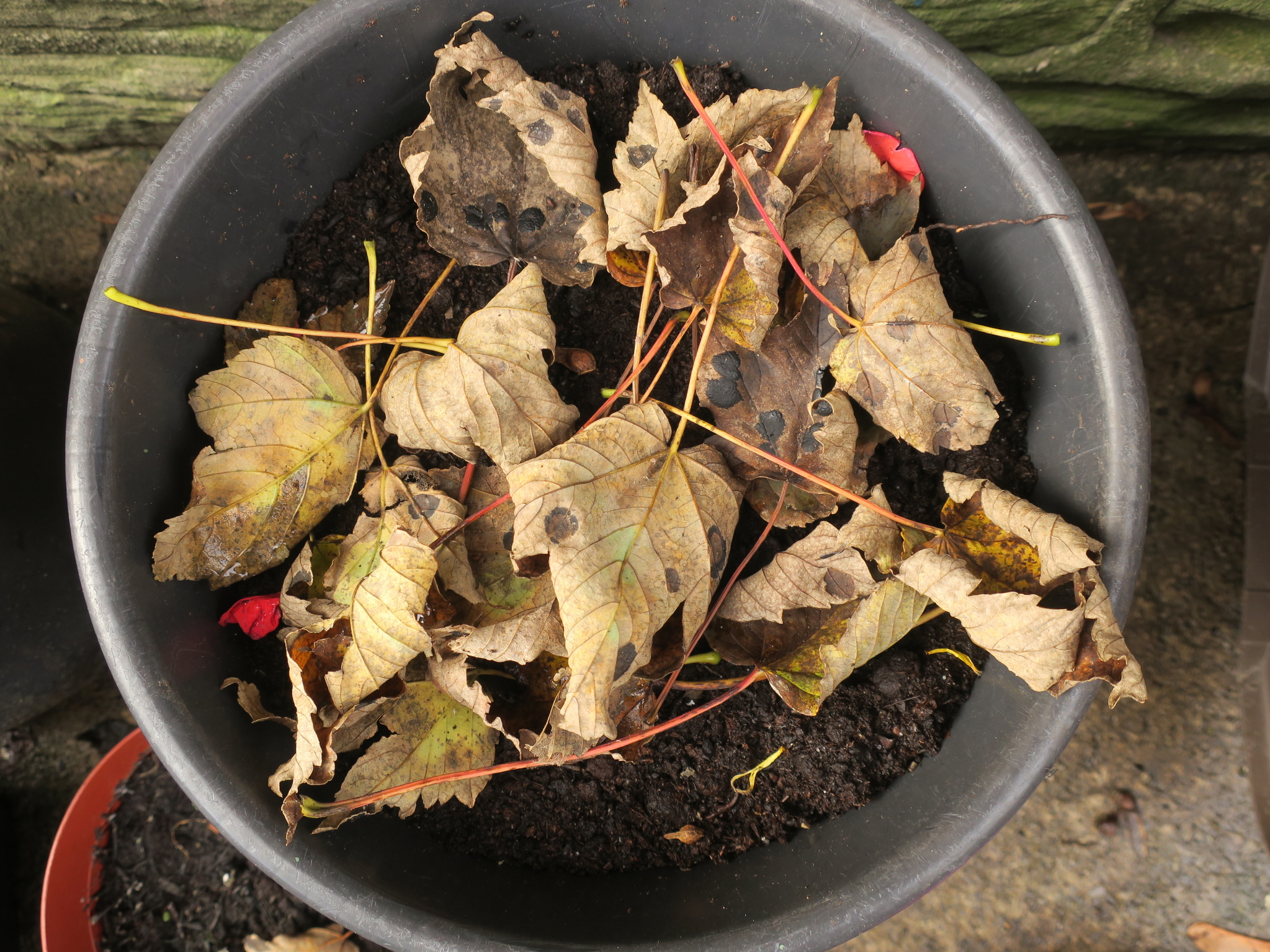
Bulbs in pot under earth, hidden by sycamore leaves to keep them warm. 1st November 2020.
Pot with bulbs under earth concealed by fallen sycamore leaves.
1st November 2020.
Also in pots, ready for next year, I have alliums, tulips and daffodils. I can't remember which are in which pot but never mind. It will be fun to see what happens. I have been piling sycamore leaves on them to keep them warm when frosts come. Sycamore leaves take ages to get soggy and flat and keep blowing away - but the moment will no doubt come when rain will win and turn them into a soggy blanket for the bulbs which are not really as deeply beneath the surface of the soil as they would probably like to be.

Seedlings in earth. 1st November 2020.
Seeds coming up in earth.
1st November 2020.

There are similar bulbs in the tiny patch of earth outside my house. I sowed some nigella (Love in the Mist) and cornflower seeds to see if they would come up with a head start and keep the marigolds company over-wintering. Some seeds are germinating. Whether they are seeds I've sown or more petty spurge I don't know! I've scattered fox gloves (I don't think they are fox gloves) and aquilegea there too . . . we will see . . . or perhaps not see if they get eaten or drowned or frosted . . . ! ! !

Cyclamen seedling. 1st November 2020.
Cyclamen seedling.
1st November 2020

Back to pots; a couple of years ago I bought red and white and pink cyclamen from a garden centre and put them in my window boxes. Only one has survived. However, they dropped seeds which grew and I have transplanted the results into pots. This is the most advanced of them.

Common Orange Lichen on small twig. 1st November 2020.
Twig with common orange lichen.
1st November 2020


And finally - look what the wind blew in. Here's a little twig with common orange lichen on it (Xanthoria parietina). It landed behind one of the pots on the door step and I placed it on the wall between me and the street to take its photo. The little metal lumps are the remains of railings. I expect they were sawn off during the second world war. The government collected up railings from the fronts of people's houses to melt down and use as part of the 'war effort'. I don't think many, if any, were actually used. Maybe it helped people feel involved. I don't know. I wasn't there. But all over England there are these sad little stumps, constant reminders of futility.

The lichen's lovely though, isn't it?

Link

"So What Really Happened to Our Railings?"  On London Gardens Trust website.


Connecting with Nature Notes on Rambling Woods.

Saturday, 1 August 2020

WELCOMING THE VISITORS

Scruffy hart's tongues ferns in wall. June 1st 2020.


Do you remember this picture?
It's of bedraggled Hart's Tongue ferns in the wall outside my house on 1st June 2020.

Something apparently unconnected; do any of you read Karen Gimson's blog? (Recommended!) Well, at the beginning of March, Karen was giving away a Hozelock Bokashi Composter and I 'won' it by leaving a comment and my name came out of the hat.

This kind of composter lives indoors. There are no worms but a sort of magical sawdust that you sprinkle onto food you put in the large-bucket sized, grey and yellow plastic box. Incredibly, it can be cooked as well as uncooked food, animal as well as vegetable. (Even bones.) I haven't been very adventurous with it. I find I am conservative about what I think 'ought' to go into a compost bin and these conventions are hard to overcome. However, feeling rather brave, adventurous and reckless even I have included pasta from time to time. It's now got to the point where I must get someone to dig a hole in the ground at my allotment and bury the contents. (Perhaps I will ask them to sing mystical chants while they do it!) But in between then and now, twice a week, I have opened a tap at the bottom and let a slightly yellow, slightly cabbagy smelling liquid flow out. I've diluted it with water and poured it over the hart's tongue ferns using a little red watering can with a long, thin spout - rather like an old fashioned oil can.

The same hart's tongue ferns on 1st August 2020/


And this is the result!

All previous hart's tongue ferns I have come across have been growing on woodland slopes or at the edge of county ditches where there would always be some kind of decaying vegetation. These must have been hungry as well as thirsty. Just look at them now! Not only have the original ones revived, more have appeared - presumably encouraged by the dribble of water and nutrients through the channels of old mortar. I've just counted forty. FORTY!

Petty spurge.
Petty spurge. 1st August 2020
Because of the rules of the pandemic and my lack of immunity to the bacteria in soil I have still not been able to visit my allotment but I'm trying to make the most of the little area outside my house. Fortunately, it's at the dead end of a blocked off street so the large pots I've placed along the pavement don't get in anyone's way. As well as extending growing space this has the advantage of expanding the distance between me (on my doorstep) and anyone who might be passing by. (Virus anti-sociability!) There's also a little concreted area where trays can go and a tiny patch of earth 70 inches by 22 inches. (I've just measured it.) During June, one of our two cats died. We buried her there and sprinkled four kinds of flower seeds which sprang up and were promptly eaten by slugs. I had some spare red kale plants whose leaves are pretty as well as edible so I planted them instead. Slugs ate them! I had grown rudbeckia from seed. I put them there. Slugs ate them! Never mind. Instead of bright colours, I have a little army of petty spurges. They just arrived. I didn't plant the hart's tongue ferns, I didn't plant the petty spurge. The big deal is that slugs and pests are avoiding both and both are now happily growing. I have a garden!

Small foxglove plant. 1st August 2020
Foxglove seeds had fallen from the garden in Dorset into a couple of pots which came with me when I moved to Halifax. Slugs and snails ignore them. They have flowered and dropped extra seed. Now transplanted into the earth, hopefully these new plants will flower next year. There are lots of foxgloves growing wild locally. When they start to drop seeds I'll collect some so I will have even more. Whatever grows (almost whatever grows!) is welcome!

Aquilegia. 5th June 2020

Remember this picture? It is of some rather exotic looking aquilegia growing nearby. I've collected seeds from them and sprinkled them on the earth. Hopefully, they will grow and I will have exotic flowers outside my house too next June. (I've kept some in an envelope and can start them in pots in spring if I need a fall back.)

Small, self-sown cyclamen now put in pots. 1st August 2020.


The trouble with cats is that they like sitting on things and my remaining cat is an enthusiastic window-box-plant-squasher. Last year I planted cyclamen in the window boxes. Squashed! Dead! Breaking my arm didn't help. I couldn't water things as much as they needed. But eight baby cyclamen have sprung up in their place. Two I've left in the boxes. The other six I am now nurturing in separate pots. Of their own accord they are perpetuating the line. They are welcome!

Lobelia flowering in stripey Yucca pot. 1st August 2020


This pot came with me from Dorset. It contains a stripy Yucca plant and a foxglove seedling. Also some lobelia. The lobelia came from Dorset - at least, its ancestors did. I bought a few plants several years ago and they have been self-seeding ever since.

Geranium in pot. Grown on from plug. 1st August 2020.


And last, but not least, geraniums. I have not been into a shop for months but Diana at Elephant's Eye on False Bay pointed out that the large windows in my house might have been intended with a weaver in mind and that weavers traditionally had geraniums in their window boxes. How could I resist? I looked online but geraniums seemed very expensive so I asked my neighbour to keep an eye out for me in the local shops and she came across a wonderful bargain - eighteen plug plants for £1:77! Enough for her to have some on her windowsills too.  I've potted them up and when they get round to flowering we will have a right gaudy and joyous display at our end of the street.

More hart's tongue ferns in the same brick wall. 1st August 2020.
Sorry, I'm so chuffed with the hart's tongue ferns I need to show you another group in the same wall.

Nature, in the form of lack of water, of slugs and snails can be destructive. But there can be hardly anywhere in this country where absolutely nothing will grow. I will not necessarily be able to have the plants I first thought of but nature (and my neighbour!) are filling the gaps. What grows is welcome. Plants which choose to be here of their own accord or are from the immediate environs are those most likely to survive - and that, so far, with a little bit of nudging, is what they are doing!

Sunday, 19 July 2020

ASH TREE: A STUCK FOOT POST

Looking up into the ash tree.
Yesterday morning a man I don't know called out a greeting. "Well done!" he shouted. I stopped.
???
"You're doing well!" he bellowed, long-distantly.
???
"Thank you!" I yelled back, puzzled.
"How old are you?"
At top voice, I told him.

This is the first time anyone has asked me how old I am since . . .

. . . well when is it that people stop asking how old you are? Fourteen? Something like that; a few years after you've stopped being precise about the months and days you've accumulated. "Five and three-quarters," you say . . . and find a way to slip in (hopefully and acquisitively yet also with pride) the date of your next birthday. Then there's a long gap before you start re-volunteering age related information . . . you are soon to be one-hundred-and-ninety-three and you remember when Noah got married.

Gash in trunk of ash tree bark.
Have I really reached an age when people shout out 'well dones' in the street simply because I am walking along with moderate speed? Not really. I resisted shouting 'I'm not as old as you think! I've been ill but I'm getting better!'

Twice, while I was being treated for leukaemia, people mistook someone older than me for my offspring. I thought I'd got beyond that. Clearly not. My hair has re-grown; white and thick, with an irritatingly purposeful wave that makes me look prim. When I was young (in my early twenties) a friend commented, "We think we aren't vain. We think we don't mind what we wear. But no way would we buy crimplene!" I feel that about my hair. I've never minded excessively about my appearance but I don't like it that my post-cancer-treatment-hair currently makes me look like a lesser version of the Queen.


Yellow flowers at the foot of the ash tree.
How is any of this relevant? Well, this morning I was thinking perhaps I didn't feel like going for a walk. Then I decided that before I age irreparably, by which I mean the kind of aging where you really are running out of years, I'd better not give up on going out walking in the early morning. So off I went. And I got  as far as round the corner when I was stopped in my tracks by a bunch of yellow flowers growing at the foot of an ash tree. The sun was catching it 'just right' and I couldn't pass by. I've still not caught up with June posts - and there are Tree Following photos in my camera . . . but the moment seemed right for a 'Stuck Foot Post'. Clearly, I thought, if I am looking old enough to be congratulated for hurrying, there's no time to hang around waiting to fill in odd gaps.

A 'Stuck Foot Post' is where you stand still and see what you can see. You can twist and turn and twizzle and you can move one foot but not the other. You can lean forward if you wish but you mustn't walk forward. One foot must remain 'stuck in place'.

Hole in tall, stone wall.
Until very recently, this road had many trees in it. First a couple were taken away because they were growing out of a wall and were pulling it over. Then a cluster of cherry trees and others were chopped down because (a local account tells) burglars hid their van behind them while engaged on raiding a series of large industrial units and the owners decided to open the view. But this ash remains. I walk past it a lot but hadn't paid it a great deal of attention till it gained the status of 'one of those remaining'.

Sorrel or dock fruits.
During May and June, there was a campaign to persuade people not to mow their lawns so small plants could flower in them to look pretty and come to the aid of struggling pollinators and quite a lot of grass around the place has grown longer than usual in consequence. Then there's the coronovirus which has taken people out of the work force so councils are not necessarily prioritising having short grass. Locally, this has led to lots of flowering plants in the streets and where the council has eventually started mowing it has sensitively left swathes of it long where poppies grow and some buttercups are still flowering, and clover. So although the broader scene of grass has now been cut, immediately round this tree there are nettles and dock and clover and ragwort (is it ragwort or something else?) and . . .  

Clover in the grass.


So I stopped, and looked, and took photographs, then set about running along (scurrying) in bursts to catch up with the morning and my fitness and my age . . . before, all of a sudden I inadvertently run out of years.

If you feel like posting a 'Stuck Foot Post', let me know the link and I'll add it here.

Saturday, 20 January 2018

WALL - A STREET PLANT POST

Selection of plants growing on a wall in Halifax, West Yorkshire.
I've decided, for the moment, to keep comparing. Contrasts are interesting. They matter.

The dark walls of Halifax and the surrounding fields bothered me when we arrived. Gloomy. I wasn't sure whether this blackness is intrinsic to the stones the walls are made from or whether it's soot. London used to be black. Westminster Abbey used to be black. Look at it now!

And I can't answer this yet. (Don't worry. I'll find out. Plenty of time.)

I'm getting used to them. What's more, they are a good place to find street plants. So it's another new experience - to look sideways and up, not just down by my feet.

The picture above . . . I think I'll have come back to this exact spot when I do my next 'stuck foot' post. I'll take photographs just of the plants in this immediate scene. So many crammed in together.

Groundsel in front of a wall. West Yorkshire.

Here's a confluence of themes. I'm getting used to a green instead of white light when it rains and finding it's interesting to notice familiar plants in a new context. Groundsel; but camouflaged. The plant and the green on the wall in the rainy late-afternoon light of a January day are in harmony. A unity. An invisibility. It's a surprise. A new experience. When it rains, black walls turn green!

Delicate plant with dark green leaves growing in cracks between stones in a wall in West Yorkshire.


I don't know what this plant is. Can you tell me?

Plant growing in shelter of stones of a wall in West Yorkshire.


What about this one?

This fern below?

Fern growing between stones in a wall. West Yorkshire.

Does it strike you that the stones look like petrified wood?

Why is this ivy red? Can anyone explain?

Red leaved ivy growing creeping to the top of a wall in West Yorkshire.

And below - a foxglove!
Until I came here, I'd not thought of foxgloves as urban wild plants. Very country hedgerow I'd have said. That was . . . until the first post on this blog when I found them growing on top of another wall.

Foxgloves and other plants on wall in West Yorkshire.

On moving from Dorset to West Yorkshire I started again with 'Loose and Leafy in Halifax'. Maybe I made a mistake. Perhaps I should have created a blog dedicated solely to this wall!


If you'd like to join me in noticing and admiring plants growing wild in towns and cities . . . I'll be putting a link box for Street Plant Posts on Loose and Leafy, 1st - 7th February.

Wednesday, 3 January 2018

WALKING THE STREETS ON CHRISTMAS DAY - A STREET PLANT POST

Preamble . . .

I don't seem to have written this well.

I enjoy living in Halifax so much I'm surprised when little things remind me of the past. That was the intention of post. But instead of saying it clearly I appear to have given the impression that I don't like it here at all. The opposite is the case. I'm really, really happy to be here - and the photographs are of things which delight me.

It'll get confusing if I re-write the post. That could result in email subscribers receiving a different version from those reading it straight from the page. But I think I must put in this extra little bit as a retrospective preface - I LOVE IT HERE!

From this point on, the post is as it was.

* * *

Grass growing on rounded cobbles.
Here is my new 'lawn'.
Grass growing on the anti-social cobbles designed specially for not walking on.
I'm thinking inevitably about the things I miss about Dorset and the things which are missing here; which are not necessarily the same. Nor are they quite what I would have expected.

I went for a walk on Christmas Day and what I missed was not the sound of the sea but the absence of dried out Prickly Lettuce (Lactuca serriolla) stalks rammed up against walls. I haven't properly worked out why. It might be that I knew in advance that Halifax is sea-less so the lack of a tide hasn't come as surprise. The pain of that absence becomes a part of life; a familiar dull throb of discomfort. But it never struck me to wonder if there would be prickly lettuce. I didn't know I'd mind. So I was surprised both by its not-here-ness and that it hurt. Is there really no prickly lettuce here or is it simply that I haven't walked past it yet? I have a kind of hankering, an irritability springing from 'not-knowing'.Not that it's pretty. It's a straight up plant with boring leaves and small, uninteresting flowers and at this time of year it's nothing but a dried out twig anyway. So who would care? This is the next lesson - that when missing things no-body else has noticed, one can feel very alone.

Moss growing at foot of tree
Part of my new moss garden. Miniature sculpture.
I've experienced it in lesser ways in Dorset . . . someone pours weed-killer onto a row of urban wild plants along the foot of a wall. They want rid of them. Other passers by are unlikely to identify the difference and I'm thinking 'where have they gone?' But such plants are resilient. They either grow back the next year or, failing that, nearby.
But not growing at all? That's something else.

Common Orange Lichen and other lichens on urban tree
Here's something Halifax has in common with Dorset
Common Orange Lichen (Xanthoria parietina)


I'm sitting here asking "will I miss Alexanders?  Chicory?  Vipers Bugloss?" Yes. But differently. They don't usually grow in the middle of towns so I'm not looking for them. It's part of the background ache. But I'd made the mistake of thinking urban plants grow in urban places and are, therefore, ubiquitous. Of course they may be. But maybe not. Dorset is warmer. Sunnier. Will I find Black Medic here or does it just like the south? Scarlet Pimpernel?

Creeper with purple flowers.
Escapees add an exotic element to an invisible street garden.
This one is wandering over a wall while retaining its domestic roots.

At the same time . . . of course I sort of did know things don't just pop up all over the place merely because they are familiar . . . I even wrote about hoping there would be dandelions. I'm inconsistent. And I discover there were so many thousands of dandelions along Dorset paths and roads and hedgerows I'd put them more in a more conventional wild-plant bracket.

Plant growing in a circle in a high, windowless wall.
This is something I would never have come across near my old home.
Indeed, I don't yet know what it is I'm looking at!


On Christmas Day when I went out to look for street plants, I set out in a business like fashion. I knew there would be some - there always are. And I would begin to construct from them my invisible urban garden. But I hadn't expected grief for such mundane things as prickly lettuce. And I hadn't expected to be swept by the power of shape. Moss grows everywhere in some form but each patch, even of the same variety, builds itself into distinct and therefore missable sculptures. I'll move from here one day so will I risk loving things that I will inevitably leave behind?

I hesitate.

On Christmas Day I went to visit the Alder I am 'following'.

I should be able to say 'yes, of course'. But I've had to think about it - hard - and with some gritting and grinding of teeth have decided Street Plant posts will continue in their new location. People with broken hearts can learn to love again.

Yellow flowers in car-park on Christmas Day
Flowers on Christmas Day!


Here then, may I proudly introduce you to my new, wild, scattered urban garden.


And assert, almost as an item of faith, that there is growth where there appears to be none.


Yes. Even when there really appears to be none.

Three blocks of flats in Halifax, West Yorkshire
Because Halifax is in a sort of bowl in the hills,
these three blocks of flats are a distinctive identifier for the town.
(Just as Big Ben is for London.)


Thursday, 19 October 2017

WALL PLANTS ON OCTOBER 16TH 2017

Plant on wall in the orange light of October 16th 2017.
You know when the sun went red earlier this week? And the sky went orange? And it was because ex-hurricane Ophelia had brought dust from the Sahara and debris from Iberian wild fires in the swirl of her skirts? It was a very wonderful orange and the atmosphere almost pre-eclipsical and it cast a special and golden glow over what was already a golden autumn.


Naturally just about everyone who owns a camera went out and took pictures.

Grass on wall.
Yellow leaves looked fantastic but, initially, my camera was keen to over-do the look, to make it seem pretty much as if we were ourselves in the middle of a forest fire or that the end of the world was truly nigh. Indeed, while I was taking a photograph of the sun - with lens pointing straight at it (what a day!) a man walking by stopped to let me know that this strangeness was not caused by humans but it was God's way of telling us the world was about to end. This might be today, tomorrow, five years time, ten years or hundred . . . but end it would . . . and that people who had accepted Jesus into their hearts (hand on chest) would be ok but everyone else would not. He said this in a very cheerful way so perhaps he's hedging his bets on a hundred-year scenario.

Small rowan on wall.
I didn't quite subscribe to his end of the world theory but if it were to be the end of the world I was anxious to get my photographs in first. So I think I should be congratulated for patiently and politely waiting for the man to stop warning me of my possibly imminent demise while what I really wanted to do was to capture the red circle which was the sun while it was there.

Previous arrivals of Saharan dust have left gritty deposits of brick red on the roofs and bonnets of cars. And on Monday I assumed the red of the sun and the orange of the light were because sand in the Sahara is red. So I pottered around town thinking about camels and celebrated the light with an ice-cream . . . and fiddled with the settings on my camera . . . and found which colours 'worked' and which were distorted in the eerie atmosphere.

Cars, vans, buildings, street.
Later, a weather forecaster explained that the reds and oranges were nothing to do with the colours of sand but that debris in the atmosphere was deflecting greens and blues from the rainbow which makes light white. (All science is daft.) But that was later. By then I'd already found I could filter out Ophelia herself and that my camera could turn everything back to 'normal' if it wanted. Or if I wanted. (That's the challenge.) So . . . while photographs of wall plants in this post show what things really looked like on October 16th, the street picture (cars, van, buildings) shows what things look like on ordinary days even though I took it when the light was orange. It's a camera lie.

Clever things cameras. Strange thing light. Funny thing reality.


To see the red sun, go to my other blog (Message in a Milk Bottle)
The Day the Sun Turned Red - 4 - The Sun
and the preceding posts
The Day the Sun Turned Red - 3 - Leaves
The Day the Sun Turned Red - 2 - Street Light
The Day the Sun Turned Red - 1 - Portrait


Sunday, 23 July 2017

ONE WALL

Ragwort and convolvulus in front of railings on a high stone wall.
It was a mistake.
I'd thought photographing familiar plants would be a good idea; a clear connection between my old life and new. But it wasn't. Seeing good old convolvulus poking through railings instead of clambering over a blackberry hedge was painful. And ragwort should be beside tracks. Those tracks might be of the narrow, foot-trodden into earth kind, or they might be railway ones . . . but that's where I expect them to be. Seeing them spread about on top of a high, black wall was disconcerting - a clash of feelings. I came back to my new home tearful and full of home-sickness.

I doubt if many people move in this direction - from the sea and sand and sunshine and fossils of Dorset to the no-sea, no-sand, not-even-a-river, less sunshine, more rain of Halifax. Explaining is difficult. To say too much perfection is eventually boring might not sound very sensible. But where I used to find it reassuring to see the same plants coming up in the same place every year, I'd begun to think 'Year in, year out, that same old plant. How predictable can you get?'

Dandelion growing between black stones of wall in Halifax, UK
Of course, a wall might seem even more predictable; being there 'year in, year out' is precisely what one expects it to be. But for me - each wall here is new. Another new thing to explore. And the less like a Dorset wall it is, the better I can cope. Abrupt change is easier than struggling with memories.

As I write this, I'm hearing what I think is Kurdish music coming in from the house next door instead of silence. And people passing by in the street are more likely to be talking Urdu with a Yorkshire accent than English. At night, in my old house, it was so quiet I could hear the street lights humming. Incessantly they hummed. And I was becoming more and more frightened by the sea - the millions and millions of tons of pebbles which make Chesil beach crashing against each other, over and over and over with each white wave. There needs to be a new word for 'hearing'. To 'hear' the roar of Chesil Beach is nothing like hearing the roar of traffic on a busy road. In order to be run down by a car you have to step in front of it. No way is it out to get you. Whereas the sea . . . it's eating into the underbelly of the cliffs till there's no rock left to hold up the tops so they crumble away or come crashing down until in some places there's nothing but grass sticking out high above the coast; and whole sections of cliffs are cracked sheer from top to bottom by alternating rain and drought - and the sea is sucking everything that falls into it greedily away.

Willow Herb and bindweed growing on a wall in Halifax with house behind.
In an era of Brexit, it's best to be clear about this from the beginning. Where I've lived until now, it would rarely come into anyone's head to mention anyone's ethnic background. For nearly everyone shares a similar heritage. Now, all of a sudden I'm being confronted with the oddness of citizens with different cultures living in different 'areas' all within the same small town . . . and of shops being defined by the ancestry of their owners - this is a Pakistani shop, this is a Polish shop, this is a 'European' shop. I think I'm classed as a 'European'. I've always thought of myself as English. And one might as well say it aloud - that to be defined as 'Eastern European' (as opposed to just 'European') round here tends to mean you are expected to be rowdy, loud, litter strewing and drunk. (I've yet to find out what the stereotype of someone like me is - so I don't yet know whether I will live up to it, or down to it - or what!)

Plants and grass growing on a blackened stone wall.

Thatched cottages are common in Dorset. Hardly any buildings are abandoned or broken. Abandoned and broken is new to me - and here 'abandoned and broken' is everywhere. The buildings which have fallen out of use are too large and too many to be turned into holiday homes for wealthy people who like to look at a bit of greenery and a few cows at the weekends.


You'd have thought that once into the the countryside I'd feel more 'at home'. But the leaves on the trees here have more blue in them. Their green heads towards emerald. And the whole landscape is over-coloured and so highly saturated it's disconcerting. It's alien. It's an adventure.

Polystyrene cup and metal cans stashed where a stone is missing in a wall with convovulus hanging down.


So . . . I hope you will adventure with me in this new land . . .

as I get used to convolulus growing thinly on black, urban walls.

A change is sometimes way more than a rest - it's a regeneration of life. Already, brushing away the tears, I can feel that new energy begin.