Showing posts with label LEAVES. Show all posts

Monday, 2 November 2020

2nd NOVEMBER 2020

Leaf shadows on trunk of tree in Autumn. 2nd November 2020.
What have I seen today?

That which I enjoyed the most were the shadows of leaves on the trunk of a tree.

When I first moved to Halifax (in West Yorkshire) I found a site where you can type in your post code and it will tell you the air quality. Halifax is a very busy town with lots of lorries and buses and cars. I anticipated the score would be low; a sad contrast, I expected, with the air I was used to in Dorset where I had lived right by the sea. But no. It came out surprisingly high. Pretty healthy stuff. I was pleased; but puzzled.

Autumn  Woods, Mount Pellon, Halifax, West Yorkshire. 2nd November 2020.
Autumn  Woods, Mount Pellon, Halifax, West Yorkshire. 2nd November 2020.

A few days ago I went on a short journey into Lancashire to visit The Forest of Bowland. It isn't a 'forest'  in the usual sense of non-stop trees - but it is very beautiful. On the way home I was entertained to see that the notice which announced I was re-entering Calderdale (this part of West Yorkshire) had a description written on it. Calderdale, it turns out is 'Ruggedly sophisticated'. My new image! The best of all worlds. I really am not sure about the 'sophisticated' bit but 'rugged' it certainly is. So rugged, so up and down, with so many steep drops in inconvenient places - there's plenty of room for trees where houses simply couldn't be. They are frequently in 'cloughs', the local word for a steep sided valley or ravine. Sometimes, often, you don't know they are there but these trees must have a huge impact on our air quality.

Autumn woods, Mount Pellon, Halifax, West Yorkshire. November 2nd 2020.


This morning, I was pottering around in the Mount Pellon area of Halifax - and that's where I saw the leaf shadows . . . and lots of autumn trees!

Path in woods under tall railway arch. 2nd November 2020


I also went under this huge arch belonging to a disused railway line.

Seedling on mossy wall. 2nd November 2020


And back up in the light . . . found this seedling growing out of a mossy wall. This seedling is almost as amusing as the 'ruggedly sophisticated' slogan because it has the air of being the kind of seedling that would want to grow into a really large plant if only it weren't sticking out of a wall . . . and if only it were a different time of year . . . and . . . it looks like a squash seedling, though perhaps it's a sunflower. Can anyone say?

Tiny white toadstools. Possibly Ivory Bonnet (Mycena flavoalba). 2nd November 2020

This afternoon I went out to look at a patch of tiny toadstools. They are spread over an area about two foot square, are white and each one is only about a centimetre across. You can see how small they are by comparing them with the size of the sycamore leaf. I put them on iSpot and a couple of people have already suggested they are 'Ivory Bonnet' (Mycena flavoalba). They are probably right - though I thought the tops of 'bonnet' fungi tended to be more pointy than these.

Tiny white toadstools close up. Possible Ivory Bonnet. (Mycena flavoalba) 2nd November 2020
Tiny white toadstools close up. Possible Ivory Bonnet.
(Mycena flavoalba) 2nd November 2020

Well, that was today! I hope you have had a good day too.

Sunday, 1 November 2020

1st NOVEMBER 2020

I don't know how it has come about that it's so long since I last posted. Here we are at the beginning of November and England is about to enter another 'Lockdown'. Not that this will have much of an impact on the way I live. I've continued to live very separately, grateful for the wonderful countryside around and the interesting area of town I live in.

For some reason it seems like the beginning of June - June when I did a post nearly every day. I can't work out exactly why this is but I think in part it's because of the very definite change in season - the winds and the rain are beating the leaves from the trees at a tremendous rate - and partly because the idea of a lockdown makes one more intensely aware of one's immediate surroundings.

So here's a little update on a small part of what's happening in the very tiny area immediately outside my front door. I put it that way because as usual, the smaller the area one examines, the more there is to see.

Harlequin ladybird on flower pot with groundsel. 1st November 2020.
Harlequin ladybird. 1st November 2020.
Let's start with the wildlife. Ladybirds are still moving around. Here a harlequin is exploring a pot containing a groundsel plant that I've been watching over the summer. Groundsel is a very common 'weed' in England; probably familiar to most readers. However, I doubt many have really paid much attention to what it's like, what it does, how an individual plant behaves. I would encourage everyone to put a pot of earth outside their door and see what happens - an empty pot with earth. In England at any rate it's almost inevitable that a seed will land there. Let it grow, see what it is, examine it. If it turns out to be a nettle, you might want to pot it on, let it grow to its full height, watch it flower. Or it might be something you have never come across before.

Snail hibernating in wall in Halifax, West Yorkshire. 1st November 2020.
Snail hibernating in brick wall.
1st November 2020
In the short wall that separates me from my neighbour, a snail has taken up residence for the winter. I was going to move it but it's further in than it looks so I'll let it be. When it comes out of hibernation and begins to wander around, I'll probably relocate it to a distance as I am not tempted by the idea of letting it feed on the vegetable seedlings I will put outside my door in spring. I say 'to a distance' because snails have an annoying homing instinct. One year I painted numbers on the snails that I removed from my garden - on their shells with typewriter correction fluid. They kept coming back. Each time I removed them further away until I found the distance from which they would not return. Number "2" was specially persistent.

Harts Tongue Fern in wall in Halifax, West Yorkshire. 1st November 2020.
Hart's Tongue Ferns in brick wall.
1st November 2020

The hart's tongue ferns in the wall are thriving. I still feed them every so often with the fluid from the Hozelock Bokashi digester which arrived via Karen. I've lost count of how many there are now. I've also poked leaves from other kinds of ferns in some of the cracks - waited till the spores on their backs were ripe and in they went. Whether they will grow or not . . . that will be another adventure. (Incidentally, a couple of leaves have appeared all by themselves which I think are probably of an ivy leaved toad flax. I hope so. I like that. Unfortunately they are on the most shady part of the wall so may not thrive.)

Pink geranium in pot and lemon balm in pot on doorstep. Halifax. West Yorkshire. 1st November 2020.
Lemon Balm and Pink Geranium in pots on steps.
1st November 2020.


On the steps to my door I have four pots. Here are two - the lower step has lemon balm, the upper one a geranium. They are getting bedraggled - but it is November!

Pot marigold heads after flowering. 1st November 2020.
The demise of pot marigold flowers and beginnings of some seeds.
1st November 2020.


On the other side of the step from the geranium is a pot marigold from Mike. I had hoped it would produce seeds but it isn't doing too well on that front. On the other hand, a couple of seeds which I planted in another pot at the same time but which didn't immediately germinate have now come up and look quite sturdy so I am hoping they will over winter well and flower early next year - the Sofa-Flying Calendula connection will continue!

Bulbs in pot under earth, hidden by sycamore leaves to keep them warm. 1st November 2020.
Pot with bulbs under earth concealed by fallen sycamore leaves.
1st November 2020.
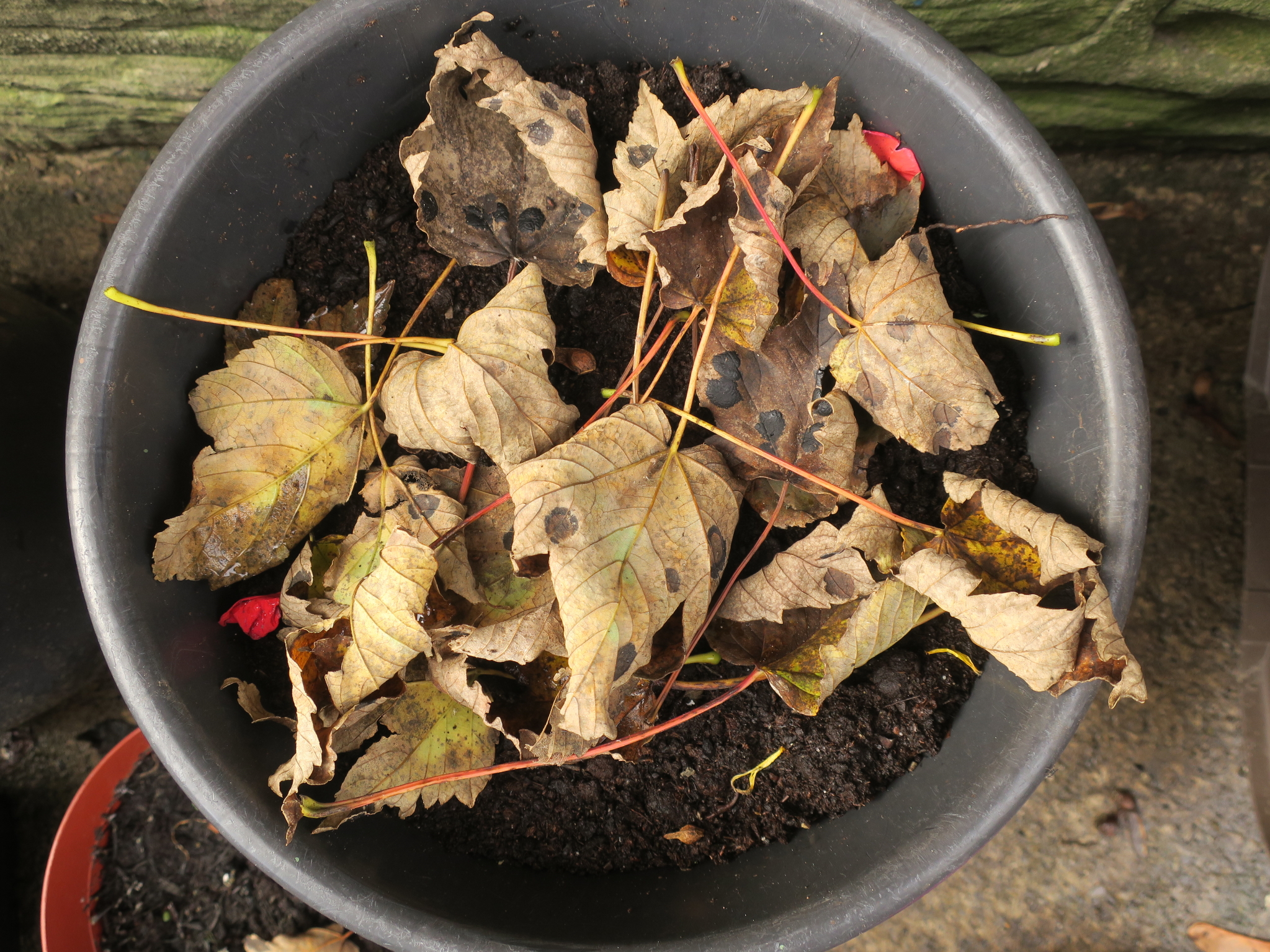
Also in pots, ready for next year, I have alliums, tulips and daffodils. I can't remember which are in which pot but never mind. It will be fun to see what happens. I have been piling sycamore leaves on them to keep them warm when frosts come. Sycamore leaves take ages to get soggy and flat and keep blowing away - but the moment will no doubt come when rain will win and turn them into a soggy blanket for the bulbs which are not really as deeply beneath the surface of the soil as they would probably like to be.

Seedlings in earth. 1st November 2020.
Seeds coming up in earth.
1st November 2020.

There are similar bulbs in the tiny patch of earth outside my house. I sowed some nigella (Love in the Mist) and cornflower seeds to see if they would come up with a head start and keep the marigolds company over-wintering. Some seeds are germinating. Whether they are seeds I've sown or more petty spurge I don't know! I've scattered fox gloves (I don't think they are fox gloves) and aquilegea there too . . . we will see . . . or perhaps not see if they get eaten or drowned or frosted . . . ! ! !

Cyclamen seedling. 1st November 2020.
Cyclamen seedling.
1st November 2020

Back to pots; a couple of years ago I bought red and white and pink cyclamen from a garden centre and put them in my window boxes. Only one has survived. However, they dropped seeds which grew and I have transplanted the results into pots. This is the most advanced of them.

Common Orange Lichen on small twig. 1st November 2020.
Twig with common orange lichen.
1st November 2020


And finally - look what the wind blew in. Here's a little twig with common orange lichen on it (Xanthoria parietina). It landed behind one of the pots on the door step and I placed it on the wall between me and the street to take its photo. The little metal lumps are the remains of railings. I expect they were sawn off during the second world war. The government collected up railings from the fronts of people's houses to melt down and use as part of the 'war effort'. I don't think many, if any, were actually used. Maybe it helped people feel involved. I don't know. I wasn't there. But all over England there are these sad little stumps, constant reminders of futility.

The lichen's lovely though, isn't it?

Link

"So What Really Happened to Our Railings?"  On London Gardens Trust website.


Connecting with Nature Notes on Rambling Woods.

Wednesday, 12 August 2020

TREE FOLLOWING - AUGUST 2020

The top of a large sycamore (sycamore?) tree. August  7th 2020.
The top of the right hand tree. Heavy with leaves. 7th August 2020.
I'm feeling overwhelmed by the trees I'm following. Initially, it felt fairly simple. These two trees are sycamores. They are immediately outside my front door. All I had to do was look at them, photograph them, post about them. So why overwhelmed?

Leaves on what may be a sycamore tree.  7th August 2020.
7th August 2020.

To some degree we can blame it on the Coronovirus. It is overwhelming - so everything is overwhelming. Even small things. I can smell gas in the cellar and am waiting for someone to find if there is a leak. One thing after another! At one point the bath, the shower and the handbasin in the bathroom were all out of action: broken or leaking. Shielding etc. have made it harder to get things mended. A train is on fire in Scotland. Floods in Scotland have floated cars in a hospital car-park overnight and when the water receded they landed on each other's roofs. I am not in Scotland. It is sunny here in Halifax this morning. But there hasn't been much sun. The skies have been almost constantly over-cast even though it's summer. Then there's Beirut - and all the calm and sensible people who live there somehow coping while I am overwhelmed by trees.

Trunks of the right hand sycamore (?) tree. August 7th 2020.
Trees can seem so BIG!
Their canopies another world. A world we can peer into but hardly touch.

Last month I took photographs so I could post about them - then didn't. I couldn't stop finding more and more to see in these trees, and more to think about. I was heading the same way in August. I peer through the branches and see what appear to be millions of creatures living there. Ladybirds, lacewings, little black flies. Between them they are a whole universe of beings. Then there's the way the two trees muddle their branches. Which tree is which? And are they even sycamores? Maybe one is some kind of maple? I'm sinking in the shapes of the seeds, the texture of the bark, the colour of the leaves, their possible names in Latin!

Seeds (Samaras) on sycamore or maple. 7th August 2020.
The winged seeds of sycamore and maples are called 'Samaras'.
(I call them 'keys' or 'helicopters'.)
So I was in danger of stopping again. Right. Take myself in hand. There will need to be a short fleet of posts. It won't fit in one.

Are you finding this too? That there are so many big things wrong with the world that even simple things seem difficult? I find I can only do things if I do them in small bites - and then celebrate. Hurray! I just swept the floor! Hurray! I just walked upstairs and back down again! Hurray! I am managing to post daily on my other blog Message in a Milk Bottle. (I really enjoy taking these simple and unconnected pictures.) Hurray! I've just written a Tree Following post for August!

tree-logo

ARE YOU?  Click the tree design to find out more.


Linking with Nature Notes at Rambling Woods.
And to Our World Tuesday

Saturday, 20 June 2020

30 DAYS WILD : DAY 20 - THREE SMALL THINGS

Fly with big brown eyes. Green


This morning I went for a walk and stopped at a stone bridge over a stream and there I saw three small things.


A fly with big brown eyes


Seed growing in moss on parapet of stone bridge


A seed growing in the moss on the parapet


Green, stripey insect.


A stripey something on a leaf with galls. It was only a few millimetres long and I have no idea what it is. Have you?

Badge and Link to 30 Days Wild 2020
Today's Random Act of
Wildness is to
see three tiny things.


Monday, 29 July 2019

TREES IN A TREE

Fern growing in a tree. Halifax, West Yorkshire.
Hello. This is an 'I'm still here, really!' sort of post. I have had the bone marrow stem cell transplant and am waiting to see if it's 'worked'. So far, so good - but nothing is definite yet. What a lot of anxious waiting!

But I'll put some pictures here of one of my favourite local trees. Not only is it huge and rugged but it supports an extra burden of plants and even trees growing along one of its lower branches.

There's a magnificent fern.

Dandelion on a branch of a tree.


And a dandelion.


Sycamore growing on another tree.


A sycamore.

(Which is not as sickly as it looks. I adjusted the image to make it easier to see against a background of other leaves and managed to sap it of all its nutrients in the process.)

Tree (beech or alder?) growing on branch of older tree.


And a . . . beech? alder? Anyone?

I think the host tree is a lime . . . . but I'll be in hospital for several more weeks so we'll need to leave that hanging.

Hope you are all well.

Saturday, 20 January 2018

WALL - A STREET PLANT POST

Selection of plants growing on a wall in Halifax, West Yorkshire.
I've decided, for the moment, to keep comparing. Contrasts are interesting. They matter.

The dark walls of Halifax and the surrounding fields bothered me when we arrived. Gloomy. I wasn't sure whether this blackness is intrinsic to the stones the walls are made from or whether it's soot. London used to be black. Westminster Abbey used to be black. Look at it now!

And I can't answer this yet. (Don't worry. I'll find out. Plenty of time.)

I'm getting used to them. What's more, they are a good place to find street plants. So it's another new experience - to look sideways and up, not just down by my feet.

The picture above . . . I think I'll have come back to this exact spot when I do my next 'stuck foot' post. I'll take photographs just of the plants in this immediate scene. So many crammed in together.

Groundsel in front of a wall. West Yorkshire.

Here's a confluence of themes. I'm getting used to a green instead of white light when it rains and finding it's interesting to notice familiar plants in a new context. Groundsel; but camouflaged. The plant and the green on the wall in the rainy late-afternoon light of a January day are in harmony. A unity. An invisibility. It's a surprise. A new experience. When it rains, black walls turn green!

Delicate plant with dark green leaves growing in cracks between stones in a wall in West Yorkshire.


I don't know what this plant is. Can you tell me?

Plant growing in shelter of stones of a wall in West Yorkshire.


What about this one?

This fern below?

Fern growing between stones in a wall. West Yorkshire.

Does it strike you that the stones look like petrified wood?

Why is this ivy red? Can anyone explain?

Red leaved ivy growing creeping to the top of a wall in West Yorkshire.

And below - a foxglove!
Until I came here, I'd not thought of foxgloves as urban wild plants. Very country hedgerow I'd have said. That was . . . until the first post on this blog when I found them growing on top of another wall.

Foxgloves and other plants on wall in West Yorkshire.

On moving from Dorset to West Yorkshire I started again with 'Loose and Leafy in Halifax'. Maybe I made a mistake. Perhaps I should have created a blog dedicated solely to this wall!


If you'd like to join me in noticing and admiring plants growing wild in towns and cities . . . I'll be putting a link box for Street Plant Posts on Loose and Leafy, 1st - 7th February.

Sunday, 19 November 2017

TREE FOLLOWING - NOVEMBER 2017 - ALDER IN HALIFAX

I confess I was tempted to abandon my town-centre tree in favour of another; something closer to home; a tree I would happen to be passing now and then rather than having to make a special point of visiting. It isn't as if it does much. We've had a wonderful and long autumn with lots of colour. But 'my' tree has trudged through the seasons in a tatty, dull-green kind of way. It's currently paying no attention to the prospect of winter in full leaf.

Small new leaf on an urban alder tree in November
But I'm giving myself a last chance to make something of it. Sometimes boring things are the most rewarding because they demand of us so much effort.

First - yes it's an alder.
Here's a leaf - a new one, with an even newer one opening beside it. November 14th!

Alder catkins / fruits


And here's a silhouette showing its catkins / fruit.

Alder leaves with patches eaten away


And here's why it's boring. 

This is a picture of the leaves on 14th November.

Alder leaves with patches eaten away

And this is how they were on 6th August. Not a lot has happened since then! Though given the way the leaves have been grazed by insects perhaps it's a moment to be impressed by its resilience.

Initially I thought I'd photographed the same leaf in both months but no longer think that's so. (Which is a pain.)

Baby's dummy on railings protecting an urban alder

Unless I were to stand by the tree for a week, clipboard in hand and interview passers by, I have no way of knowing how other humans engage with this tree. Someone stuck a dummy on it's protective railing. But that seems very impersonal. It's the railing that's caught attention. Not the tree. Here it is in August.

Baby's dummy and coca-cola bottle on railings protecting an urban alder


And here it is in November. Perhaps even the railings are invisible to most people for the dummy is still there. The only change is that a coke bottle has been added to the scene. (And that scaffolding has been put up around the Victoria Theatre.)

Green Barred Alder aphids on an alder leaf.
Two small leaves towards the foot of the tree were neatly stuck together when I arrived, one flat on top of the other. Carefully I peeled them apart. I'm always wary of doing this; never sure if I should. Whoever's in there I'm intruding on a life; possibly destroying it.

Aphids. I've been searching around and think they are mostly Green Barred Alder Aphids (Pterocallis maculata). Perhaps there are Common Alder Aphids too (Pterocallis alni)? I don't know. What do you reckon? And what about the little yellow dots? Are they eggs? Galls? Anyone?

One boring tree - with a thriving little empire held between two of its tiniest leaves. Perhaps not boring after all. I'll be back next month - whether I can hit the Tree Following deadline or not!

* * *
ALDER LINKS

APHID LINKS

Aphid Information on the Site Influential Points:

For Pterocallis maculata (Green Barred Alder Aphid) and others see Aphids on Alder (Alnus)