Showing posts with label LADYBIRDS. Show all posts

Sunday, 1 November 2020

1st NOVEMBER 2020

I don't know how it has come about that it's so long since I last posted. Here we are at the beginning of November and England is about to enter another 'Lockdown'. Not that this will have much of an impact on the way I live. I've continued to live very separately, grateful for the wonderful countryside around and the interesting area of town I live in.

For some reason it seems like the beginning of June - June when I did a post nearly every day. I can't work out exactly why this is but I think in part it's because of the very definite change in season - the winds and the rain are beating the leaves from the trees at a tremendous rate - and partly because the idea of a lockdown makes one more intensely aware of one's immediate surroundings.

So here's a little update on a small part of what's happening in the very tiny area immediately outside my front door. I put it that way because as usual, the smaller the area one examines, the more there is to see.

Harlequin ladybird on flower pot with groundsel. 1st November 2020.
Harlequin ladybird. 1st November 2020.
Let's start with the wildlife. Ladybirds are still moving around. Here a harlequin is exploring a pot containing a groundsel plant that I've been watching over the summer. Groundsel is a very common 'weed' in England; probably familiar to most readers. However, I doubt many have really paid much attention to what it's like, what it does, how an individual plant behaves. I would encourage everyone to put a pot of earth outside their door and see what happens - an empty pot with earth. In England at any rate it's almost inevitable that a seed will land there. Let it grow, see what it is, examine it. If it turns out to be a nettle, you might want to pot it on, let it grow to its full height, watch it flower. Or it might be something you have never come across before.

Snail hibernating in wall in Halifax, West Yorkshire. 1st November 2020.
Snail hibernating in brick wall.
1st November 2020
In the short wall that separates me from my neighbour, a snail has taken up residence for the winter. I was going to move it but it's further in than it looks so I'll let it be. When it comes out of hibernation and begins to wander around, I'll probably relocate it to a distance as I am not tempted by the idea of letting it feed on the vegetable seedlings I will put outside my door in spring. I say 'to a distance' because snails have an annoying homing instinct. One year I painted numbers on the snails that I removed from my garden - on their shells with typewriter correction fluid. They kept coming back. Each time I removed them further away until I found the distance from which they would not return. Number "2" was specially persistent.

Harts Tongue Fern in wall in Halifax, West Yorkshire. 1st November 2020.
Hart's Tongue Ferns in brick wall.
1st November 2020

The hart's tongue ferns in the wall are thriving. I still feed them every so often with the fluid from the Hozelock Bokashi digester which arrived via Karen. I've lost count of how many there are now. I've also poked leaves from other kinds of ferns in some of the cracks - waited till the spores on their backs were ripe and in they went. Whether they will grow or not . . . that will be another adventure. (Incidentally, a couple of leaves have appeared all by themselves which I think are probably of an ivy leaved toad flax. I hope so. I like that. Unfortunately they are on the most shady part of the wall so may not thrive.)

Pink geranium in pot and lemon balm in pot on doorstep. Halifax. West Yorkshire. 1st November 2020.
Lemon Balm and Pink Geranium in pots on steps.
1st November 2020.


On the steps to my door I have four pots. Here are two - the lower step has lemon balm, the upper one a geranium. They are getting bedraggled - but it is November!

Pot marigold heads after flowering. 1st November 2020.
The demise of pot marigold flowers and beginnings of some seeds.
1st November 2020.


On the other side of the step from the geranium is a pot marigold from Mike. I had hoped it would produce seeds but it isn't doing too well on that front. On the other hand, a couple of seeds which I planted in another pot at the same time but which didn't immediately germinate have now come up and look quite sturdy so I am hoping they will over winter well and flower early next year - the Sofa-Flying Calendula connection will continue!

Bulbs in pot under earth, hidden by sycamore leaves to keep them warm. 1st November 2020.
Pot with bulbs under earth concealed by fallen sycamore leaves.
1st November 2020.
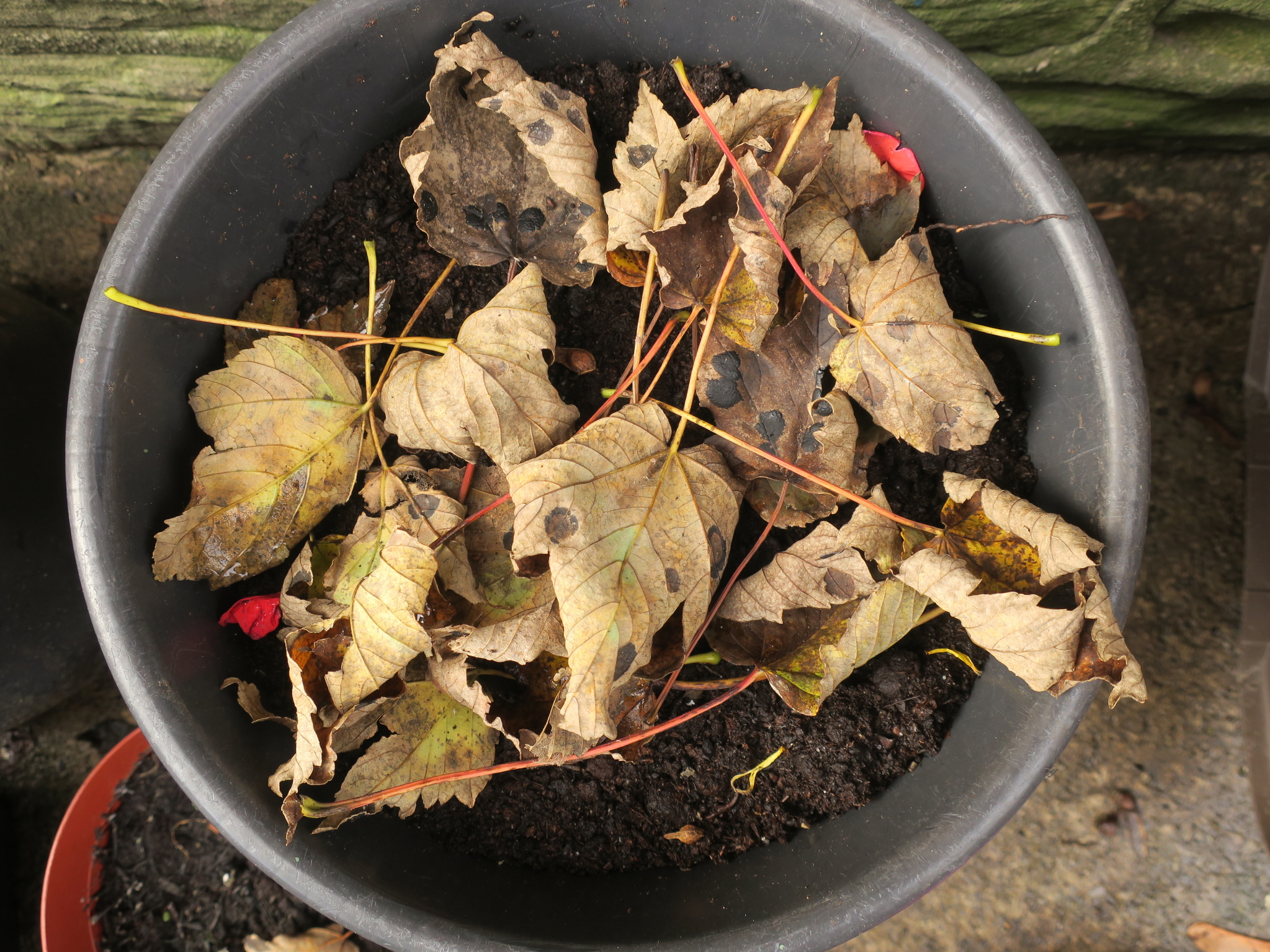
Also in pots, ready for next year, I have alliums, tulips and daffodils. I can't remember which are in which pot but never mind. It will be fun to see what happens. I have been piling sycamore leaves on them to keep them warm when frosts come. Sycamore leaves take ages to get soggy and flat and keep blowing away - but the moment will no doubt come when rain will win and turn them into a soggy blanket for the bulbs which are not really as deeply beneath the surface of the soil as they would probably like to be.

Seedlings in earth. 1st November 2020.
Seeds coming up in earth.
1st November 2020.

There are similar bulbs in the tiny patch of earth outside my house. I sowed some nigella (Love in the Mist) and cornflower seeds to see if they would come up with a head start and keep the marigolds company over-wintering. Some seeds are germinating. Whether they are seeds I've sown or more petty spurge I don't know! I've scattered fox gloves (I don't think they are fox gloves) and aquilegea there too . . . we will see . . . or perhaps not see if they get eaten or drowned or frosted . . . ! ! !

Cyclamen seedling. 1st November 2020.
Cyclamen seedling.
1st November 2020

Back to pots; a couple of years ago I bought red and white and pink cyclamen from a garden centre and put them in my window boxes. Only one has survived. However, they dropped seeds which grew and I have transplanted the results into pots. This is the most advanced of them.

Common Orange Lichen on small twig. 1st November 2020.
Twig with common orange lichen.
1st November 2020


And finally - look what the wind blew in. Here's a little twig with common orange lichen on it (Xanthoria parietina). It landed behind one of the pots on the door step and I placed it on the wall between me and the street to take its photo. The little metal lumps are the remains of railings. I expect they were sawn off during the second world war. The government collected up railings from the fronts of people's houses to melt down and use as part of the 'war effort'. I don't think many, if any, were actually used. Maybe it helped people feel involved. I don't know. I wasn't there. But all over England there are these sad little stumps, constant reminders of futility.

The lichen's lovely though, isn't it?

Link

"So What Really Happened to Our Railings?"  On London Gardens Trust website.


Connecting with Nature Notes on Rambling Woods.

Saturday, 12 September 2020

A LADYBIRD SUMMER

It wasn't very many years ago that I first came across a ladybird larva - that particular one was a purple and black spiky little monster on a honeysuckle bush. And now I have come across ladybird pupa for the first time - funny little bright blotchy lumps stuck to flower pots and rubbish bins. And I've become more aware of where ladybirds are - surprising places like snuggling in lumps of sheep's wool on barbed wire fences. Here is a selection of observations from the last few months.

First is a seven spot ladybird (27th June 2020) on a dying plant in town. I wonder what it is doing there. I've peered into the photo looking to see if there are aphids for it to eat. No. I worry about it retrospectively. Why was the plant dying? Had someone poisoned it? Would the ladybird die too? What is it about ladybirds that we can't help feeling drawn towards them? Concerned for them. I really like coming across hover flies but I'm never tempted to invest them with personalities in the way I am with ladybirds.

Seven spot ladybird on dying plant in town. 27th June 2020.
27th June 2020

Here's another (on the 8th August 2020) on the food waste bin outside my house - a harlequin I think. The council provides us with several different kinds of containers to throw things away in and each is a place to find ladybirds . . . and ants! If you zoom in you will see it has a thread attached. These threads are everywhere. I don't know what they are.

Harlequin ladybird on food waste bin. 8th August 2020.
8th August 2020

The next day I came across a strange cluster of at least three seven spots (I think) settled together in a bundle of sheep's wool. It's a warm sunny day. Why are they there?

Seven spot ladybirds clustered in sheep's wool on barbed wire fence. 9th August 2020.
9th August 2020

I'll zoom in for you on this one.

Seven spot ladybirds clustered in sheep's wool on barbed wire fence. West Yorkshire. 9th August 2020.

On 28th August I come across a ladybird pupa (harlequin?) fixed to the outside of a steamed up car window. I think the white feathery bits are where it is attached. This attachment is quite firm. I had to remove another from a plant pot so I could wash it up and it was quite an effort. It may well have been a mistake to move it. Apparently they can flip up on these 'hinges' to avoid parasites. Trying to learn things from the internet leaves one very patchy. The inside of one of these bright little lumps is more or less liquid as it is formed into the more familiar beetle. How can it know when to flip up? How can it 'know' anything? I'm hoping some expert will tell me in the comments so I can change this text from bewildered wonder into proper information!

Harlequin ladybird pupa on steamed up car window. 28th August 2020.
28th August 2020

I'm going in date order through the year. It's not till the 31st August 2020 that I photograph a harlequin larva - the kind of creature that has turned into the pupa with the soup inside. Like the ladybird in the second picture it has a mysterious thread attached. It's on the big wheelie bin (with the ants). Do click on the picture to enlarge it. It is a most extraordinary creature.

Harlequin ladybird larva on wheelie bin. 31st August 2020.
31st August 2020

And on 2nd September 2020 - another (harlequin?) pupa in the hinge of the wheelie bin lid.

Harlequin ladybird pupa in hinge of wheelie bin. 2nd September 2020.
2nd September 2020

The pupa stage lasts only three to twelve days. How can the miracle of changing from a little spiky monster into soup and then into a ladybird happen in such a short time?  If I were a real scientist I would probably start breaking them open to see what is happening but I am not. And they are real creatures.

Something else puzzling me. Earlier in the year there were thousands, possibly millions of aphids, in the sycamore trees. I'm not coming across them now. What do ladybirds eat in the autumn?

I ask Google. According to Nature's Calendar ladybirds eat scale insect, mildew, plants and pollen - it depends what variety they are. On the National Insect Week page about the seven spot it says they eat each other. Oh joy! Why did I ask?

Last year I read a book about octopusses, squid and cuttlefishes. (Other Minds - The Octopus and the Evolution of Intelligence by Peter Godfrey-Smith.) It was very disconcerting. On the cover there's a quote from a review in The Times newspaper. "Fascinating and often delightful". Fascinating. Yes. Delightful? No. Horrifying. So many of the fascinating facts seem to have been discovered through interference in their lives. Why do we want to know about creatures to the extent that we will mutilate, torture and keep them captive? One octopus, kept in a tank, would damage equipment and squirt people. Good on him / her! I say. (I'm getting cross.) (Read it and see.)

Incidentally, I'm getting cross too about the push to build electric cars. To make enough batteries we, we humans that is, will need to dredge the sea floor for cobolt. So . . . we've worked our way through fossil fuels which have taken millennia to create, harmed the atmosphere as we've burned them up, and now we're moving on to something else to dig, scrape, desecrate. Meanwhile, I enjoy using my laptop which is made from metal and plastic. And I drink tea (transported across the world) from a mug made from clay (dug from the earth and which, when it breaks, will be finished with). And I am glad I was born in this century - because the horrors of the industrial revolution are over and I can reap its benefits without having to labour in a mine or a pre-unionised factory. Oh, it is so difficult to be moral!

I would like to visit other countries. I'd love to see the world. And maybe one day I will. I'm fascinated to know how other creatures function too - octopuses and ladybirds alike. But we have to curb some of our desires to push forward. (How do we know which ones? To what extent?) Some of you have been kind enough to say that reading my blog brings you hope and peacefulness. We need that. You also enjoy looking at the little things you find here; things you might otherwise pass by. May I encourage you too to look at the little things around you. Try looking in the hinges of your rubbish bins . . . in fragments of waste caught on fences and walls . . . these ignominious places. Because there are wonders there to rival the octopuses. Miracles of little monsters which turn into soup then re-form into spotty beetles.  (What are all those spikes and colours for?) (Unanswerable question!) I have not been outside the UK in nearly ten years. And before that . . . it was about twenty years. Those visits were important. In England there's a lot of hardening; a lot of narrowness. We, as a nation, seem to be getting frightened of everything that isn't 'us'. And we are being more and more tempted into a slim idea of what 'us' means. If we travelled more, maybe we wouldn't be so frightened of what's 'beyond'. So there's the tension. Can we travel enough that we can learn to love our neighbours but little enough that we don't destroy the world? Can we be curious about our fellow creatures without feeling compelled to harm them? Can we be happy to stay at home? Can we be content to look without 'knowing'?

We need to know lots.
We don't need to know everything. Ladybirds on the RHS site.

Links UK - more than 40 kinds
Nature's Calendar - the ladybird page
Learn About Ladybirds - BBC Breathing Spaces
Life Cycle of Ladybirds - on the Ladybird Challenge (Help discover the balance between 7 spot ladybirds and their parasite Dinocampus coccinellae)
Harlequin Ladybirds on the RHS site.

Links USA - around 140 kinds

Tuesday, 14 August 2018

THE BIGGER PICTURE (AND THE LITTLE)

Seven spotted ladybird (probably) on radish leaf. Coccinella septempunctata
Seven Spotted Ladybird
I began paying closer attention to the flowering radishes when
I noticed cabbage white butterflies were preferring them to
the adjacent purple sprouting broccoli plants. 
I've had a letter from the committee. A perfectly sensible one asking if I can cope with having so much allotment space when the larger section isn't tidy enough.

It's true. I'm struggling to get all the carpet etc. disposed of, and allowing more wild plants to grow around the place than is conventional (or acceptable) on a public allotment. In part this is because I've paid most attention recently to the half allotment I took over fresh from someone who had put a lot of care and attention into it. I wanted her to know I am looking after it. There's also the challenge of staying in all day for plumbers when they aren't able to give a precise time for their arrival. So watering had taken priority over weeding.

But it's more than that. Through the years I've been paying so much attention to the small things around us I've lost the ability to see 'the bigger picture'. By this I'm talking in purely visual terms. Instead of digging everything over, I've been fretting that I haven't yet taken photographs of the variety of grasses on the site and every day I've left them till 'tomorrow'. And even when 'weeding' on parts of the plot under cultivation, I've been reluctant to pull things out. After all, they got there first, the grasses and wild plants. It was their home before I supplanted them with runner beans.

So . . . admitting to my failure, I set to work to put things on a more conventional keel.

Willow Herb flower (with Marjoram flower on its right)
Willow Herb
In real life the willow herb flower is pinker than in the picture
but the light was dull and the photo came out like this.
(To the right is a marjoram flower. The colour is right for that.)
I stood at the top of the main plot and tried to see it as if through the eyes of others. The first thing I noted was willow herb; not enough for my taste but enough to draw attention to itself because it stands higher than other plants, the flowers are of a bright and startling pink and the white curls of their opening seed pods are truly attractive when activated on individual plants rather than in a clump (where they look messy). My willow herb plants were spread about the plot and looked magnificent: flowers and pods at all their stages. But being the first thing one might notice when taking in the broader scene they had to be the first to go. Straight away the plot looked different; more boring but more tidy too. Stage one!

Common Frog (Rana temporaria)
Removing the wilds plants reveals a Common Frog (Rana temproaria).
There's still shelter for it in between and under the plastic crates.
Next . . . the grasses. Their stems of flowers and seeds (depending on the variety) were the tallest unintentional plants once the willow herb had gone. (All but one willow herb plant down near the compost bin - I had to keep one, didn't I?) So I snapped off the stems, pulled out the plants where they'd ease easily from the powdery ground with one tug. And if neither worked I slid the seeds off onto my own soil and snipped the rest off later. I got a bit irritable about this. The wind might well take willow herb seeds to other plots but most of the grasses on mine produce heavy seeds which plop directly to the ground. But they've gone.

Redshank flower
Redshank
Next, the path between my plot and the untended one beside it. I'd forgotten completely about this path. It's rough and odd and I have two others to walk down so I'd let it be. Out came nearly all the extraneous plants. Another clear difference achieved. (I left a redshank plant. Couldn't take out everything!)

With five sacks of 'weeds' I appealed to a friend to take them to the council dump in his car. Once he'd agreed to that I set about packing carpet into bin liners as an extra. It will take many more car loads to get it all away (many, many, many) and in terms of how the allotment looks, its removal makes little or no difference - but it pleases me more than getting rid of willow herb and dead nettle and redshanks and beautiful grasses.

If I hadn't kept taking time off to look at the 'little' things as I went, I'd probably have achieved much more in the time. But I can't stop doing it. See a fly - grab my camera. Pull a weed out by its roots - photograph the roots.

Redshank plant with roots.
Uprooted Redshank
And in this I see something of an advantage in having an allotment instead of just looking at the vegetation around hedgerows. Hedgerows have to be left as they are. However interested one may be in knowing what's underground, one can't go around pulling up wild flowers to take a peep. (Different location, different terminology.) But if the wild plants on my allotment have to go anyway then wa-hey . . . I can examine their roots. I have a new angle. When I take in the larger scene I now realise there's another of the same size beneath it. It's not a mirror. It's completely different. And I'm allowed to go there!

P.S. I used to go to iSpot a lot to help identify plants and insects and to confirm (or otherwise) things I thought I already knew. Then it slowed down so much it became almost impossible to use. That was a while back so I thought I'd give it another go. It's faster now than it ever was and a pleasure to use. I'm back to recommending it.