Showing posts with label BADGERS. Show all posts

Wednesday, 3 June 2020

30 DAYS WILD: THREE - BADGER'S SKULL

Badger's skull from above.
Most years, if you register to take part in The Wildlife Trusts' '30 Days Wild' challenge, you are sent an action pack - a calendar to fill in, stickers to put on it. This year, because of the virus, they are sending it out by email and you have to print your own. My printer is broken. Huh!

One of the suggestions in my downloaded pack is to make a nature table - and there's a squared chart with suggestions of what to put on it . . . feathers and fur, petals and grasses . . . I'm not going to be doing that but if I concentrate, I find my house is already a sort of modest nature table so in the spirit of the challenge I thought that, over the course of the month, I'd introduce you to a few of the things I have lying around.

Badger's skull from the front.


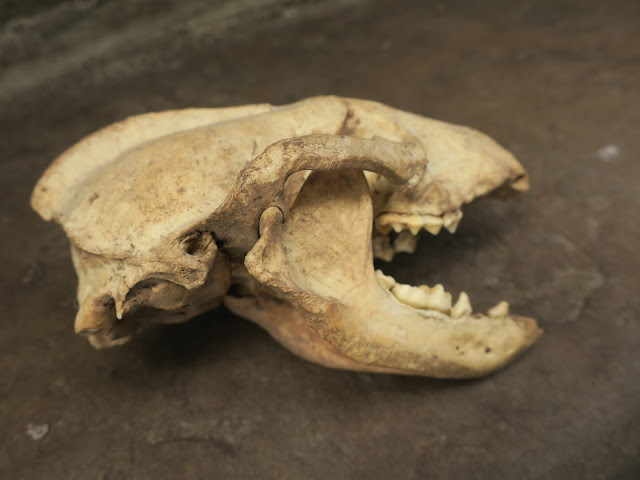
On the first square you are invited to place 'Rocks, stones, fossils and bones'; so here is a badger's skull. It comes from Hampshire (I did not find it myself) and is nearly 60 years old. It lives on the bookcase.

Every so often I mention iSpot for the interest of people who have not already come across it. It was started by OPAL and the Open University. The idea is that when you take photographs of plants, insects, birds, fungi, mammals, fish . . . you can upload them. If you know what you've seen, you say. If not, others will help with the ID. It's free to use and the agreement is that the Open University can use the photos you've submitted if it finds them useful. In the process, an interesting catalogue of natural history is accumulating.

Badger's skull from the side.


While preparing this post I had a bit of a crisis. Is it definitely a badger's skull or could it have belonged to a fox? So I put it on iSpot to find out.

Badger's skull upside down.

I confess I can't work out how iSpot works in different countries. The UK and Ireland go together. That much is clear. But when I looked at contributions under the heading 'Help With Global Identifications' I found a couple from South Africa, one from Scotland and one from Berkshire (which is in England). I'm not sure what 'global' means then in this context. And I'm assuming it doesn't work from everywhere. But for those in the UK and Ireland (and South Africa) it's very useful. If you are accessing it from other parts of the world . . . well, I don't know. Maybe there's a way the site can tell where you are and you will get appropriate instructions. Try it. (And perhaps you will let me know how you get on?)
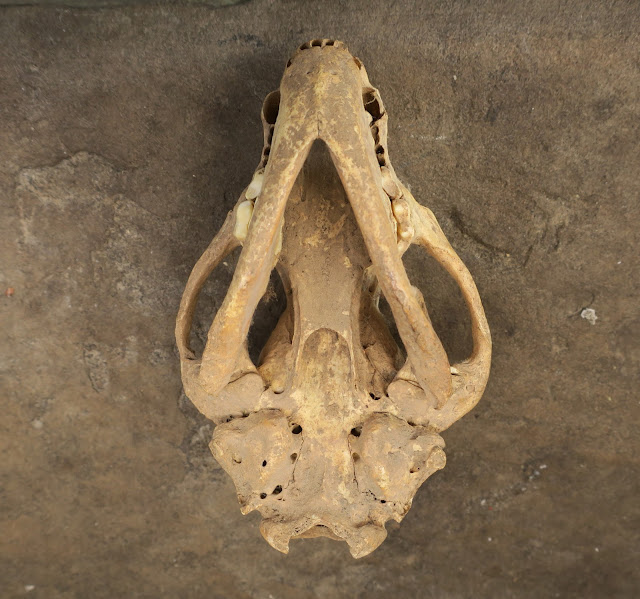
Underside of badger's skull.

I put photos of the skull on iSpot and at the point when I'm writing this, two people have agreed it once belonged to a badger. One of them also made a very important point - that I should have put a ruler or something in the photo to show its dimensions. It's true. I should have thought of that and should have done it automatically. I will re-photograph with a ruler or measure-tape. When I do, it will show that the skull is five and a quarter inches from end to end.


Badger's skull showing empty teeth cavities in upper jaw..

P.S.
1. Here's something you might like to do as one of your own wild-life related activities; enter for the 'Isolation Wildlife Photography Awards'. The closing date is June 8th 2020. There are no prizes. The organisers are hoping the challenge in itself and the quality of the judges will draw you in.

Badger skull, lower jaw.
2. The latest addition under the 'Identifying Things' tab at the top of the blog is the People's Trust for Endangered Species - Key species and habitat index page. (How to offer practical help to creatures like hedgehogs and chafer beetles along with information about other projects which aim to support animals like Tamarind monkeys and stop the trade in rhino horn.)

It's not too late to join '30 Days Wild'. Click the badge to register. 

Badge and Link to 30 Days Wild 2020
30 DAYS WILD
Today's act of
random wildness
is to put bones on a
nature table.
 

Here's a link to iNaturalist . Similar in intent to iSpot and used by people in the USA and South Africa and other places round the world.

Thursday, 12 October 2017

FEEDING CREATURES

Onion seedling on Halifax allotment.
Onion seedling. Here one day, gone the next. 9th September 2017.
My allotment neighbour and I say little. We call out a cheery 'good morning' or say 'see you tomorrow' as we wave goodbye. We have few words in common. We speak different languages. But we both know 'slugs'. She showed me a heavily nibbled vegetable. Later she waved a big container of slug-pellets, pointed at it and smiled.

She may be right. My onion seeds germinated and vanished. I think I had kohlrabi seedlings at one point. It's of no account. Whatever they were, they've gone.

I planted fifty ornamental alium bulbs; badgers came over night and dug them up leaving one left on the surface. I replanted it.

Red clover germinating under a heavy black mesh
On the upside, I now I have a use for some of the rubbish strewn around the place. I covered the bulb bed (which may now be an empty bed except for one flower) with plastic mesh and weighted it down with old bricks. The next day, I sprinkled red clover seeds through it. The seeds weren't meant to be scattered across the surface of the soil but I was reluctant about dismantling my badger defences. The germination rate was wonderful; visible. But only briefly. Mesh may deter badgers but slugs sniffed at it and surged in.

Brussels Sprouts Plant
This week I planted curly kale and Brussels sprouts plants from a garden centre. The big windows in our new house light our rooms surprisingly well - but the sun isn't strong enough to properly warm our sills. Everything gets a bit bedraggled. They had been there for a while before I had time to move them. None the less, I cleared a new bed and interspersed the slightly unhappy plants with slug traps. Beer is conventional. Milk works just as well and the plants have survived. But the half buried traps were soon dug up and overturned. Badgers!

I'm assuming badgers. There are round indentations where they've placed their feet. And round indentations where they've pressed their snouts into the soil searching for worms. And there are diggings which go nowhere. And slimy grey poo! (Next time I find some I'll show you.) And the soil, though not sandy, is fine. I suppose they like that.

The beginnings of a compost heap.
The red blob which looks suspiciously like a tomato is a crab apple.
At least, I hope it's a crab apple.
I wouldn't intentionally to put tomatoes or potatoes in compost.
I now have compost bin where I feed brandling worms from Dorset with specially bought veg. from here. Rats have found it and burrowed in. We can buy rat poison in the allotment shop but I've blocked their first hole with a stone.

In theory there are carrot seeds between the rungs of an old wooden cot side tugged out of the long grass and weighted down against badgers. But slugs are undeterred by wooden bars. So . .  no carrots!

I have onion sets and peas to put in. (Seed-selling sites recommend which varieties can be planted at this time of year.)

I hope slugs enjoy them.
Long live badgers who cavort in my newly dug beds.
And a toast to the birds which don't seem to be there to feast on the seeds.

Could do with a robin for company though. Or a blackbird.

Or perhaps not. Do robins and blackbirds eat slugs? I think they might be interested only in worms. Maybe they eat other things too for some of the time but when you are digging - it's worms.
And pigeons would want brassicas and peas.
Bother wildlife!

* * *
LINKS

'How do Slugs Eat?' - Natural History Museum of Los Angeles County.
For masses of information about badgers - Badgerland.