I don't know how it has come about that it's so long since I last posted. Here we are at the beginning of November and England is about to enter another 'Lockdown'. Not that this will have much of an impact on the way I live. I've continued to live very separately, grateful for the wonderful countryside around and the interesting area of town I live in.
For some reason it seems like the beginning of June - June when I did a post nearly every day. I can't work out exactly why this is but I think in part it's because of the very definite change in season - the winds and the rain are beating the leaves from the trees at a tremendous rate - and partly because the idea of a lockdown makes one more intensely aware of one's immediate surroundings.
So here's a little update on a small part of what's happening in the very tiny area immediately outside my front door. I put it that way because as usual, the smaller the area one examines, the more there is to see.
 |
Harlequin ladybird. 1st November 2020.
|
Let's start with the wildlife. Ladybirds are still moving around. Here a harlequin is exploring a pot containing a groundsel plant that I've been watching over the summer. Groundsel is a very common 'weed' in England; probably familiar to most readers. However, I doubt many have really paid much attention to what it's like, what it does, how an individual plant behaves. I would encourage everyone to put a pot of earth outside their door and see what happens - an empty pot with earth. In England at any rate it's almost inevitable that a seed will land there. Let it grow, see what it is, examine it. If it turns out to be a nettle, you might want to pot it on, let it grow to its full height, watch it flower. Or it might be something you have never come across before.
 |
Snail hibernating in brick wall.
1st November 2020 |
In the short wall that separates me from my neighbour, a snail has taken up residence for the winter. I was going to move it but it's further in than it looks so I'll let it be. When it comes out of hibernation and begins to wander around, I'll probably relocate it to a distance as I am not tempted by the idea of letting it feed on the vegetable seedlings I will put outside my door in spring. I say 'to a distance' because snails have an annoying homing instinct. One year I painted numbers on the snails that I removed from my garden - on their shells with typewriter correction fluid. They kept coming back. Each time I removed them further away until I found the distance from which they would not return. Number "2" was specially persistent.
 |
Hart's Tongue Ferns in brick wall.
1st November 2020 |
The hart's tongue ferns in the wall are thriving. I still feed them every so often with the fluid from the
Hozelock Bokashi digester which arrived via
Karen. I've lost count of how many there are now. I've also poked leaves from other kinds of ferns in some of the cracks - waited till the spores on their backs were ripe and in they went. Whether they will grow or not . . . that will be another adventure. (Incidentally, a couple of leaves have appeared all by themselves which I think are probably of an ivy leaved toad flax. I hope so. I like that. Unfortunately they are on the most shady part of the wall so may not thrive.)
 |
Lemon Balm and Pink Geranium in pots on steps.
1st November 2020. |
On the steps to my door I have four pots. Here are two - the lower step has lemon balm, the upper one a geranium. They are getting bedraggled - but it is November!
 |
The demise of pot marigold flowers and beginnings of some seeds.
1st November 2020. |
On the other side of the step from the geranium is a pot marigold from
Mike. I had hoped it would produce seeds but it isn't doing too well on that front. On the other hand, a couple of seeds which I planted in another pot at the same time but which didn't immediately germinate have now come up and look quite sturdy so I am hoping they will over winter well and flower early next year - the
Sofa-Flying Calendula connection will continue!
 |
Pot with bulbs under earth concealed by fallen sycamore leaves.
1st November 2020. |
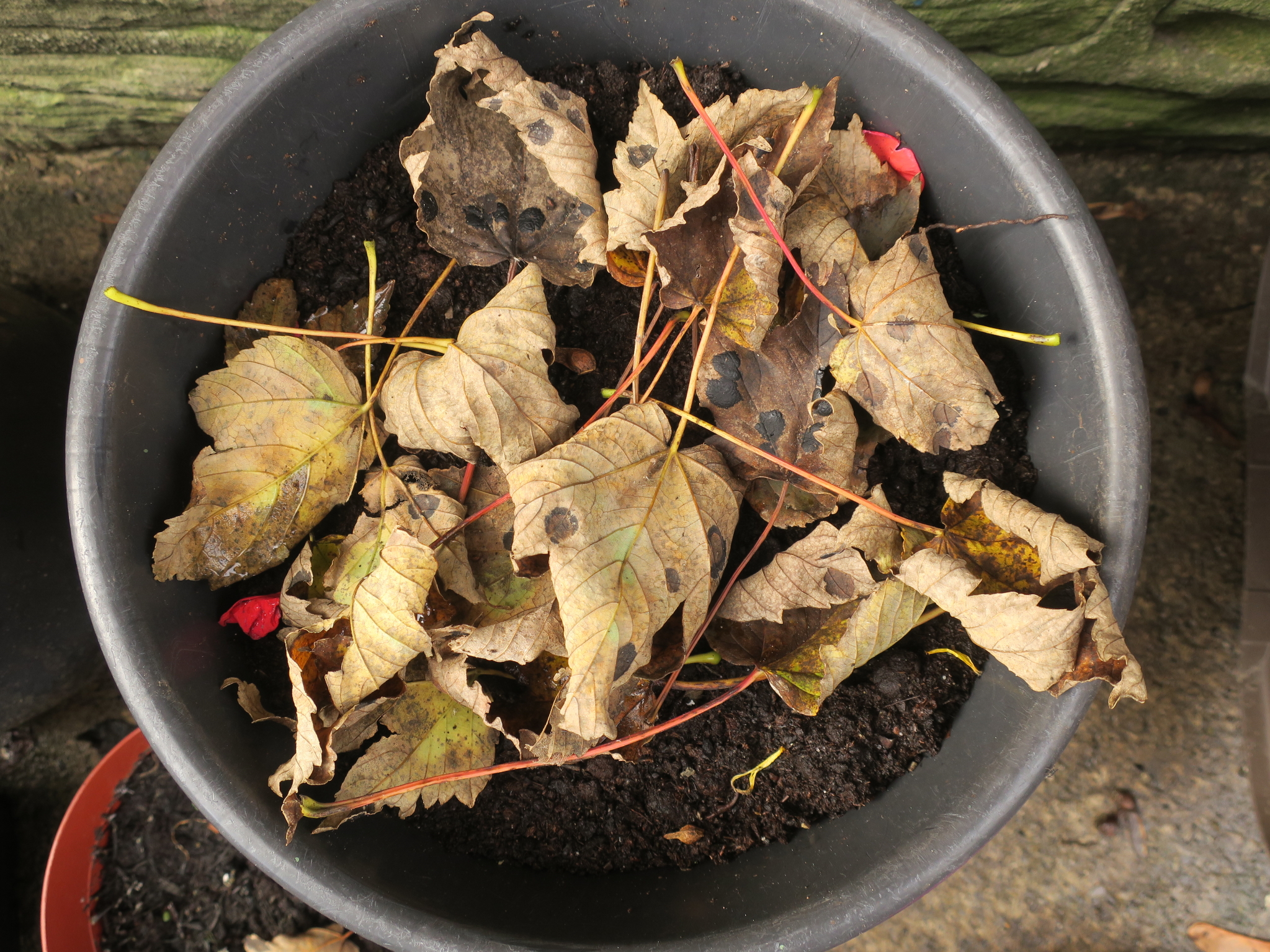
Also in pots, ready for next year, I have alliums, tulips and daffodils. I can't remember which are in which pot but never mind. It will be fun to see what happens. I have been piling sycamore leaves on them to keep them warm when frosts come. Sycamore leaves take ages to get soggy and flat and keep blowing away - but the moment will no doubt come when rain will win and turn them into a soggy blanket for the bulbs which are not really as deeply beneath the surface of the soil as they would probably like to be.
 |
Seeds coming up in earth.
1st November 2020. |
There are similar bulbs in the tiny patch of earth outside my house. I sowed some nigella (Love in the Mist) and cornflower seeds to see if they would come up with a head start and keep the marigolds company over-wintering. Some seeds are germinating. Whether they are seeds I've sown or more petty spurge I don't know! I've scattered fox gloves (I don't think they are fox gloves) and aquilegea there too . . . we will see . . . or perhaps not see if they get eaten or drowned or frosted . . . ! ! !
 |
Cyclamen seedling.
1st November 2020 |
Back to pots; a couple of years ago I bought red and white and pink cyclamen from a garden centre and put them in my window boxes. Only one has survived. However, they dropped seeds which grew and I have transplanted the results into pots. This is the most advanced of them.
 |
Twig with common orange lichen.
1st November 2020 |
And finally - look what the wind blew in. Here's a little twig with common orange lichen on it (Xanthoria parietina). It landed behind one of the pots on the door step and I placed it on the wall between me and the street to take its photo. The little metal lumps are the remains of railings. I expect they were sawn off during the second world war. The government collected up railings from the fronts of people's houses to melt down and use as part of the 'war effort'. I don't think many, if any, were actually used. Maybe it helped people feel involved. I don't know. I wasn't there. But all over England there are these sad little stumps, constant reminders of futility.
The lichen's lovely though, isn't it?
Link
"So What Really Happened to Our Railings?" On London Gardens Trust website.